Originally shared by Greg Isenberg on Twitter.
What is a multi-agent AI setup and why does it matter for marketers?
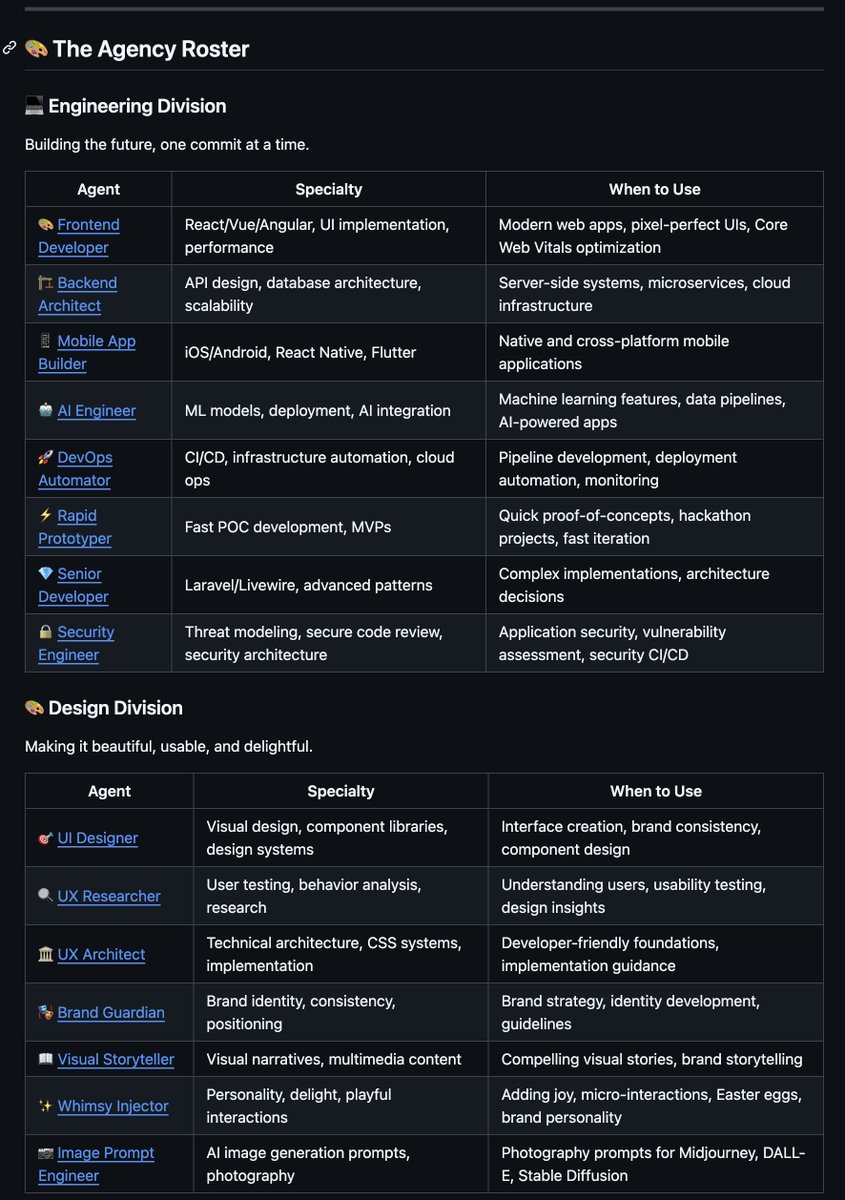
Most AI tools give you one assistant that tries to handle everything. A GitHub repo called msitarzewski/a… takes a different approach: it structures AI agents the way a real company is structured, with dedicated roles, clear responsibilities, and handoffs between teams.
The repo hit 10,000+ stars in under seven days, which is a strong signal that a lot of people think this model is worth paying attention to.
How does the team structure break down?
The repo organizes agents across eight departments:
- Engineering (7 agents): frontend, backend, mobile, AI, DevOps, prototyping, senior development
- Design (7 agents): UI/UX, research, architecture, branding, visual storytelling, image generation
- Marketing (8 agents): growth hacking, content, Twitter, TikTok, Instagram, Reddit, app store
- Product (3 agents): sprint prioritization, trend research, feedback synthesis
- Project management (5 agents): production, coordination, operations, experimentation
- Testing (7 agents): QA, performance analysis, API testing, quality verification
- Support (6 agents): customer service, analytics, finance, legal, executive reporting
- Specialized (6 agents): multi-agent orchestration, data analytics, sales, distribution
For a solo founder or small marketing team, the marketing department alone — eight specialized agents covering content, growth, and five social platforms — is worth exploring on its own.
Why does specialization matter for AI outputs?
When you ask one AI to write a TikTok script, draft a Reddit post, and prioritize your product backlog in the same session, context degrades fast. The outputs become generic.
Specialized agents stay focused. A Reddit agent trained on subreddit norms will produce copy that sounds less like an ad and more like a community member. A growth hacking agent can focus on top-of-funnel experiments without getting distracted by customer support tickets.
According to McKinsey's 2023 State of AI report, teams that use AI in a structured, workflow-integrated way are three times more likely to report measurable cost savings than teams using AI in ad hoc, single-task modes. The structure matters as much as the technology.
What should small marketing teams actually do with this?
You don't need to clone this repo and deploy the full system today. The more useful takeaway is the framing itself:
- Map your current marketing tasks to roles. Content, paid ads, social, analytics, and SEO are already separate functions — treat them as separate AI contexts, not one big conversation.
- Use separate chat threads or projects per function. Most AI tools (ChatGPT, Claude) support persistent projects or memory. Create one per marketing channel.
- Write role-specific system prompts. A prompt that opens with "You are a B2B LinkedIn content writer for a SaaS startup" will outperform a blank chat window every time.
- Build handoffs. Draft your content agent's output, then feed it into a separate editing or SEO agent. Treat it like a real workflow.
This isn't about running 30 AI agents simultaneously. It's about being deliberate with context instead of throwing everything at a single conversation.
Is this ready to use in production?
The repo is new and hasn't been widely stress-tested. Do your own research before plugging it into anything business-critical. But the underlying idea — structured AI roles that mirror how real teams operate — is a mental model worth adopting now, regardless of which tools you use.