By Pablo Bravo
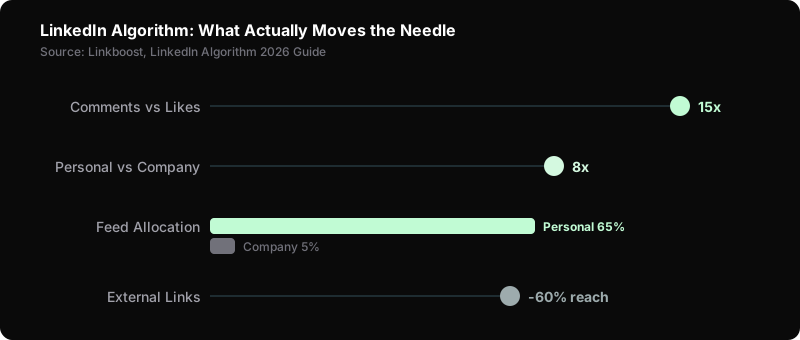
LinkedIn in 2026 gives personal profiles 8x more engagement than company pages. That's not a typo. The platform now allocates 65% of feed space to individual creators and just 5% to company pages. For B2B founders, this is the best free distribution channel available, if you post as a person, not a brand.
The platform has 1 billion+ members. Comments carry 15x more algorithmic weight than likes. And the new "Depth Score" algorithm rewards content people actually read, not content they scroll past. LinkedIn's 2026 algorithm penalizes engagement bait and external links by 60%.
This guide covers profile optimization, the 4 post types that work, hook formulas you can copy, a posting-cadence framework, the comment strategy that builds your network, and how to turn LinkedIn engagement into actual leads.
For broader social media strategy, start with our social media marketing guide, and pair it with these SaaS marketing hacks for B2B distribution.
Key Takeaways
- Personal profiles get 8x more engagement than company pages on LinkedIn
- Comments carry 15x more algorithmic weight than likes
- 3-5 posts per week, Tuesday-Thursday mornings, gets the best results
- The comment-first strategy: engage on 10 posts before publishing your own
Why Does LinkedIn Still Matter for B2B?
LinkedIn matters for B2B founders because it's the one free channel where buyers already show up in a work mindset. Average engagement sits at 3.85% in 2026, with top creators clearing 6%+ (Linkboost 2026). Tech and SaaS accounts average 3.6%, marketing agencies 3.7%. No other social platform converts B2B attention this reliably. Three factors compound the advantage. Decision-makers read LinkedIn with intent, not just entertainment. Organic reach for personal profiles stays generous while other networks throttle it. And a single post has a 48-72 hour shelf life, far longer than a tweet's roughly 18-minute window (Sprout Social 2026). LinkedIn also drives 80% of B2B social leads, more than every other platform combined (Digital Applied 2026). For a bootstrapped founder, that mix of reach, intent, and longevity makes LinkedIn the highest-leverage free channel available.

Here's what changed: LinkedIn's 2026 algorithm now measures how long people engage with your content, not just whether they clicked. Dwell time, saves, and private shares all factor into "Depth Score." This rewards thoughtful content over clickbait hooks.
The practical takeaway: treat LinkedIn as your primary owned audience, not a syndication afterthought. A founder posting three times a week reaches more qualified buyers than a paid campaign at the same stage. If you're building organic growth and hate traditional marketing, this is the one platform worth your time. It also feeds every other channel: your best LinkedIn posts become newsletter fodder, sales-call talking points, and raw material for a lazy content marketing system that recycles one idea across formats.
How Do You Optimize Your Profile for Conversions?
Optimize your LinkedIn profile by treating it as a landing page, not a resume. Profiles with keyword-optimized headlines receive up to 40% more views (LinkedIn 2026), and every view is a potential lead. Five elements do the heavy lifting: headline, banner, Featured section, About section, and Experience. Most founders waste all five with job titles nobody searches. Your headline should name the audience, the result, and one proof point. Your banner should replace the default blue gradient with a value proposition or social proof. Your Featured section should pin three assets, because empty is the default and default converts nothing. Your About section's first two lines are all that show before "see more," so they carry the pitch. And your Experience should read as accomplishments, not responsibilities. Fix these before you write a single post. A great post that sends traffic to a dead profile wastes the reach you worked for.
Headline Formula
Don't write: "CEO at StartupName"
Write: "I help [audience] achieve [result] | [Credential/Proof Point]"
Example: "I help B2B founders get their first 100 customers | Built 3 startups to $1M ARR" (if that's your promise, our first 100 users guide backs it up).
This tells profile visitors what you do for them, not what your title is.
Banner Image
Replace the default blue gradient with a banner that shows: your value proposition, social proof (logos, metrics), or a CTA. Canva has free LinkedIn banner templates at 1584x396px.
Featured Section
Pin your 3 best pieces: a high-performing post, your lead magnet, and your best case study or article. This section is prime real estate, and most founders leave it empty.
About Section
First 2 lines are all that show before "see more." Make them count. Lead with what you help people achieve. Include specific results. End with a CTA ("DM me about X" or link to your newsletter).
Experience Section
Write accomplishments, not responsibilities. "Grew revenue from $0 to $500K in 12 months" beats "Responsible for business development."
What Are the 4 Post Types That Work?
Four post formats consistently outperform for founder accounts: the personal story, the contrarian take, the how-I-did-it, and the data share. Native text posts averaged 28% higher reach than carousels across 147 B2B accounts in 2026 (Linkboost 2026), because the Depth Score rewards dwell time and saves over format novelty. Each of the four works for a different reason. Stories activate memory and empathy. Contrarian takes trigger debate, which drives comments worth 15x a like. How-I-did-it posts get saved, and saves signal value to the algorithm. Data shares position you as a source others quote. Pick a rotation across all four rather than repeating your favorite. The mistake founders make is posting only advice, which reads like every other feed. Concrete numbers, real timelines, and a point of view are what separate a post that reaches 400 people from one that reaches 40,000.

1. The Personal Story
Share a real experience: a failure, a lesson, a turning point. Be specific with numbers and timeline. "In March 2025, I lost my biggest client (32% of revenue). Here's what I rebuilt in 90 days..." outperforms abstract advice every time. Stories activate different brain pathways than information posts.
2. The Contrarian Take
Challenge a common belief in your industry with data. "Everyone says you need a sales team. We hit $500K ARR with zero salespeople. Here's how." These posts get the highest comment volume because people want to agree or push back.
3. The How-I-Did-It
Break down a specific result step by step. "How I went from 0 to 1,000 email subscribers in 60 days" with real steps, real numbers, real tools (our email marketing guide covers the list-building side). Actionable posts get saved and shared.
4. The Data Share
Share original data, survey results, or benchmarks from your business. "We analyzed 500 cold emails. Here's what we found." Original data is uncopyable and positions you as an authority. The same instinct powers relationship-based link building: give people numbers they can cite, and they'll spread your name for you.
Hook Formulas That Stop the Scroll
The first two lines decide whether anyone reads the rest, because LinkedIn truncates everything after them. Steal these five patterns:
- The number drop: "We spent $0 on ads and hit $500K ARR. Three moves made the difference."
- The confession: "I ignored LinkedIn for two years. That mistake cost me an estimated 40 clients."
- The contrarian flag: "Cold outreach isn't dead. You're just doing the boring version."
- The list promise: "7 posts got me 90% of my inbound leads last quarter. Here they are."
- The before/after: "18 months ago: 200 followers, zero leads. Today: 12K followers, 4 clients a month from LinkedIn."
Write the hook last, after the post exists, so it promises exactly what the body delivers.
What to Avoid
Engagement bait: "Agree? Comment YES!" LinkedIn's algorithm now penalizes this pattern by 60%.
Poll abuse: Polls used to get massive reach. LinkedIn has throttled poll distribution significantly.
External links in posts: Posts with links get 60% less reach. Put links in the first comment instead.
How Often Should You Post (and When)?
Post 3-5 times per week on LinkedIn for the best organic reach, with Tuesday through Thursday mornings driving peak engagement (Sprout Social 2026). Below two posts weekly, the algorithm deprioritizes you in follower feeds, so consistency beats occasional big swings. Above five, most founders hit fatigue and quality drops. The rhythm matters as much as the count. Morning slots, roughly 7-9 AM in your audience's timezone, catch the commute-and-coffee scroll before meetings start. Monday competes with weekend catch-up, and Friday posts die by noon. LinkedIn also tests each post with a small sample first, then expands distribution only if the first hour performs. That means timing and availability compound: post when your network is awake, then answer every early comment fast. The framework below turns those rules into a repeatable weekly plan you can run in about 30 minutes a day without burning out.
The First-Hour Rule
LinkedIn tests your post with a small audience first. If engagement is strong in the first 60 minutes, it expands distribution. So post when your network is active, and be available to respond to every comment within that first hour. Block 20 minutes after publishing. Reply to each comment with a real follow-up question to keep the thread alive.
A Simple Weekly Cadence Framework
Run a four-block system so you never stare at a blank composer:
- Batch on Sunday. Draft all three posts for the week in one 45-minute sitting. Batching beats daily improvisation.
- Rotate the four types. Never post two stories back to back. Variety keeps the feed fresh and trains the algorithm on range.
- Comment before you post. Spend 15 minutes engaging first, so your profile is already warm when your post drops.
- Review every two weeks. Pull your top three posts, note the format and hook, and do more of what worked.
Content Cadence Example
| Day | Post Type | Time |
|---|---|---|
| Tuesday | Personal story | 8 AM |
| Wednesday | How-I-did-it | 7:30 AM |
| Thursday | Data share or contrarian | 8 AM |
| Friday (optional) | Curated insight or repost | 9 AM |
The Comment Strategy That Builds Your Network
Commenting is the fastest free growth tactic on LinkedIn because comments carry 15x more algorithmic weight than likes (Linkboost 2026). One thoughtful comment on a high-reach post can generate more profile visits than your own content. The mechanic is simple: every comment places your name and headline in front of the original author's audience. Comment on someone with 50,000 followers, and your insight rides along to their entire network for free. The habit that works is comment-first. Before you publish anything, spend 15-20 minutes replying to 10 posts in your niche. Not "Great post!" but an actual insight, a respectful disagreement, or a relevant story from your own business. Aim to be one of the first five commenters, since early comments earn the most visibility. Done daily, this compounds: your face shows up in the same feeds until people recognize you before you ever ask for a connection.

How to Comment Strategically
- Find 20-30 accounts in your niche. Follow them.
- When they post, be one of the first 5 commenters. Early comments get more visibility.
- Add a genuine insight, respectful disagreement, or relevant personal experience.
- Keep comments 2-4 sentences. Substantial enough to add value, short enough to read.
Why This Works
Every comment puts your profile in front of the post author's audience. If you comment on someone with 50,000 followers, your insight is visible to their entire network. This is free exposure that compounds daily.
The math: 10 comments per day x 5 days = 50 comment appearances per week. After a month, you've shown up in hundreds of relevant feeds, without posting a single time.
How Do You Turn LinkedIn Into a Lead Pipeline?
Turn LinkedIn into a pipeline with a repeatable system, because visibility alone doesn't close deals. LinkedIn already generates 80% of B2B social media leads (Digital Applied 2026), but the founders who convert that reach run three mechanics on repeat. First, they DM people who engage meaningfully, within 24 hours, with a conversation starter and not a pitch. Second, they end one in five posts with a soft newsletter CTA, moving the relationship to email where sales actually happen. Third, they drop lead-magnet links as the first comment, sidestepping the 60% reach penalty that in-post links carry. The order matters: content earns attention, comments and DMs turn attention into conversations, and email closes. Track how many DMs turn into calls each month, and you'll know exactly which posts drive revenue. Content without a capture step is just reach you rented and gave back.
The DM Framework
When someone engages meaningfully with your content (thoughtful comment, not just a like), send a genuine DM within 24 hours. Not a pitch. A conversation starter.
Template: "Hey [Name], your comment on my [topic] post was spot on, especially the point about [specific thing they said]. Curious, are you dealing with [problem your product solves] at [Company]?"
Newsletter CTA
End 1 in 5 posts with a soft CTA to your email list. "I write about [topic] every Tuesday. Link in my profile if you want it in your inbox." Don't pitch your product in content, pitch your newsletter. The sales happen in email, ideally through a welcome sequence that converts.
Lead Magnet in Comments
Post your content. Then drop your lead magnet link as the first comment: "Grabbed the full template? Link here: [URL]." This avoids the algorithm penalty for links in post body while still capturing leads.
For founders who prefer direct outreach, pair LinkedIn with cold emails that get replies. The two channels compound each other: warm someone up in the feed, then reach their inbox as a familiar name.
Frequently Asked Questions
How many LinkedIn followers do you need to generate leads?
You can generate B2B leads with 500 connections. List size matters less than engagement quality. A founder with 1,000 engaged connections in their niche outperforms a marketer with 50,000 passive followers. Focus on connection quality, and send personalized connection requests to people in your target market.
Should I post from my personal profile or company page?
Personal profile, every time. LinkedIn gives personal profiles 8x more engagement and 65% of feed allocation vs 5% for company pages. Post as the founder. Use your company page for job listings and company updates only.
Do LinkedIn carousels still work in 2026?
Mixed data. An analysis of 147 B2B accounts found native text posts averaged 28% higher reach than carousels in 2026. Carousels still work for educational content, but the algorithm now rewards dwell time over format. Test both, and let your audience decide.
Is LinkedIn Premium worth it for founders?
Not for organic content. Premium doesn't boost your post reach. InMail is useful for cold outreach, but only if you have a clear target list. Start with free. Upgrade only when you've maxed out organic growth and need InMail for specific outreach campaigns.
How long should LinkedIn posts be?
1,200-1,500 characters for text posts (about 200-250 words). Long enough to provide value. Short enough to read without fatigue. Use line breaks every 1-2 sentences for mobile readability, since 60%+ of LinkedIn users browse on mobile.
Sources
- Linkboost, "LinkedIn Engagement Rate Benchmarks 2026," retrieved 2026-06-29, https://www.linkboost.co/blog/linkedin-engagement-rate-benchmarks-2026/
- Linkboost, "LinkedIn Algorithm 2026 Guide," retrieved 2026-06-29, https://www.linkboost.co/blog/linkedin-algorithm-2026-guide/
- Sprout Social, "LinkedIn Statistics for 2026," retrieved 2026-06-30, https://sproutsocial.com/insights/linkedin-statistics/
- Digital Applied, "LinkedIn Statistics 2026: 140+ B2B Marketing Data Points," retrieved 2026-06-29, https://www.digitalapplied.com/blog/linkedin-statistics-2026-b2b-marketing-data
- Sprout Social, "Social Media Statistics 2026," retrieved 2026-06-29, https://sproutsocial.com/insights/social-media-statistics/
- LinkedIn Marketing Solutions Blog, "Creator and Profile Best Practices," retrieved 2026-06-30, https://www.linkedin.com/business/marketing/blog