Forty-three percent of startups fail because there's no product-market fit, according to CB Insights' 2024 analysis of 431 failed VC-backed companies. Your first 100 users exist to tell you whether you're in that 43% before you burn through your runway. Not after.
This isn't a scaling guide. Scaling comes later. Right now, you need 100 real people using your product, giving you feedback, and telling you what's broken. Every channel below was picked because it costs $0 and works in week one.

Key Takeaways
- 43% of startups die from poor product-market fit; your first 100 users are a validation exercise, not a growth exercise (CB Insights, 2024)
- Personal network outreach alone should net 20-30 users in week one
- Personalized cold emails can increase reply rates by up to 142% (Woodpecker, 2026, 20M+ emails analyzed)
- Dropbox grew from 100K to 4M users in 15 months via referrals (Drew Houston, 2010)
Why Are Your First 100 Users Harder Than the Next 10,000?
Forty-three percent of startups fail because they never find product-market fit, according to CB Insights (2024, 431 failed companies analyzed). Your first 100 users aren't a growth milestone. They're a survival test that tells you whether your product solves a real problem before your runway disappears.
Your first 100 users are a validation exercise, not a scaling exercise. Nobody knows your name. There's no social proof, no reviews, no word of mouth. You earn each one manually.
Paul Graham put it bluntly in his 2013 essay "Do Things That Don't Scale": the most successful YC startups did things that felt like busywork in the early days. Airbnb founders went door to door in New York. Stripe's founders installed their software on people's laptops during conversations. Manual, personal, unscalable.
The goal at this stage isn't efficiency. It's learning. You want to find out what message resonates, which type of person stays, and what feature they use most. If you're spending more than 30 minutes on your landing page copy before you've talked to 10 real potential users, you're optimizing the wrong thing.
For a broader view of growth channels at every stage from $0 to $100K MRR, we break down which ones work when.
How Many Users Can You Get From Your Personal Network?
Personal network outreach typically converts at 40-60% when the ask is specific and time-bounded, making it the highest-converting early channel. Paul Graham's 2013 essay "Do Things That Don't Scale" documented how Y Combinator's most successful startups relied on manual, personal outreach to acquire their first 20-30 users before any scalable channel existed.
Twenty to thirty. Seriously. Most founders underestimate this because asking friends feels awkward. Get over it.
Write a list of every person who could plausibly benefit from what you built. Former colleagues. Industry contacts on LinkedIn. Friends who've complained about the problem you're solving. Classmates from university or bootcamps.
Then send each one a direct message. Not a mass email. A personal note:
"Hey [name], I've been building [product] for [specific person type]. I thought of you because [specific reason]. Would you try it and give me honest feedback? Takes about 10 minutes."
Why does this work? Because it's specific and direct. You're not asking them to "check out your startup." You're asking for a favor with a clear time commitment. People say yes to 10-minute favors when the ask is personal.
This is also where you learn your first positioning insights. Pay attention to which people respond, which ones actually use the product, and which ones ghost you. Those patterns tell you who your real user is.
If you're starting with zero followers and no existing audience, personal outreach is your highest-conversion channel in week one.
Where Should You Find Users in Online Communities?
Buffer grew from zero to 100,000 users after cofounder Leo Widrich wrote roughly 150 guest posts in nine months, with guest blogging driving over 70% of daily signups during that period (Search Engine Watch, 2012). Online communities offer the same principle at smaller scale: go where your audience already gathers instead of building your own from scratch.
Reddit, Indie Hackers, Hacker News, niche Slack groups, Discord servers, and Facebook groups. Your target users already congregate somewhere. Find them there before you try to build your own audience.

Buffer's cofounder Leo Widrich wrote approximately 150 guest posts on other blogs in nine months, helping Buffer grow from 0 to 100,000 users. Guest blogging accounted for over 70% of their daily signups during that period (Search Engine Watch, 2012). You don't need to write 150 guest posts. You need to find 3-5 communities where your people actually hang out.
Here's how to do it without getting banned:
- Lurk first. Spend one week reading, not posting. Understand the culture and what people complain about.
- Give before you ask. Answer questions with real, useful answers that have nothing to do with your product.
- Mention your product only when relevant. Someone asks about the exact problem you solve? That's your moment. Link to it with context, not a pitch.
One warning: don't paste the same message across multiple subreddits on the same day. Moderators will ban you, and your reputation in that community is gone permanently. Our guide to Reddit marketing covers how to promote without getting nuked.
For a list of specific communities sorted by size and niche, check 30 places to get users.
Target: 15-25 users from 3-5 communities over 2-3 weeks.
Does Cold Outreach Actually Work for Early Users?
Highly personalized cold emails boost reply rates by up to 142% compared to generic sends, based on Woodpecker's analysis of 20 million+ emails (2026). Meanwhile, campaigns under 50 recipients average a 5.8% reply rate versus 2.1% for large sends (Instantly, 2026). Small, targeted batches consistently outperform mass outreach for early-stage startups.
Cold outreach has a bad reputation because most people do it badly. Done right, it's one of the most direct paths to your first users. The trick: lead with the problem, not your product.
Customized subject lines improve open rates by up to 50%, and highly personalized emails can increase reply rates by up to 142%, according to Woodpecker's analysis of 20 million+ cold emails. Meanwhile, Instantly's 2026 benchmark report found that campaigns under 50 recipients average a 5.8% reply rate vs 2.1% for large sends. Small, targeted batches win.
A cold email template that works at this stage:
- Subject: Short, specific, about them ("Quick question about [their exact role/problem]")
- Line 1: One sentence about them, not you
- Body: The problem you think they have, in plain language
- Ask: One clear request. A 15-minute call or a free trial. Not both.
Tools to find emails: Apollo.io, Hunter.io, LinkedIn Sales Navigator (free trial). You don't need to buy a $200/month tool at this stage. Hunter's free tier gives you 25 searches per month, and that's enough for week one.
For a deeper dive on structuring your outreach sequence and avoiding spam filters, read our cold email guide. And if you're worried about email deliverability, you should be; it's the hardest part.
Target: 50-100 emails sent to get 10-15 users over 2 weeks.
How Do You Run a Product Hunt Launch?
A 2024 survey of Product Hunt launchers found that nearly half attracted 500-2,000 visitors on launch day, with featured products pulling 1,000-5,000 visitors (MySignature.io, 2024). That's meaningful traffic for a pre-traction startup, but preparation separates the launches that convert from those that just generate a traffic spike.
Product Hunt can deliver 500-1,000 website visitors in a single day. That's meaningful traffic for a pre-traction startup, but only if you prepare.
Key preparation steps:
- Build relationships early. Connect with active Product Hunt users 2-3 weeks before launch. Comment on other launches. Be genuine. People remember names they've seen before.
- Nail your tagline. Under 60 characters. Specific about what it does and who it's for.
- Prepare assets. A demo GIF or short video, 5+ screenshots, a clear first comment explaining why you built it.
- Pick your day. Tuesday through Thursday outperform Monday and Friday. Competition is lower mid-week.
- Coordinate your network. Ask supporters to upvote and leave authentic comments on launch day. Not before, not a week later. Launch day.
Indie Hackers is the other launch platform worth your time. Post a "roast my product" or "looking for beta users" thread. The community skews toward makers and developers who give genuinely useful feedback.
Neither platform guarantees 100 users alone. But if your product appeals to developers, makers, or small business owners, they're high-signal channels.
Target: 5-15 engaged users from Product Hunt + Indie Hackers.
How Do You Use LinkedIn and X for Direct User Acquisition?
LinkedIn connection requests average a 28.5% acceptance rate, with personalized requests pushing acceptance to 45%, according to Expandi's 2026 benchmark data (13.2 million data points). Sales Navigator filters let you target by job title, company size, industry, and recent hiring activity, making LinkedIn the most precise free channel for B2B user acquisition.
If your product serves a specific professional type (HR managers, freelance designers, SaaS founders), LinkedIn is a direct line to them.
A process that works:
- Use LinkedIn search filters: job title + company size + location.
- Send a connection request with a short note. Not a sales pitch. Just: "I'm building something for [their role] and would love to connect."
- After they connect, send one message asking for 15 minutes of feedback. Frame it as research, not a sale.
On X, search for people tweeting about your problem using keywords. Reply to their tweets with a genuine response. Follow up in DMs only if the conversation warrants it.
We've covered the full X marketing system for solo founders, and the case for why you should DM your ideal users instead of posting into the void.
Budget 1-2 hours per day for outreach. Keep a spreadsheet: who you contacted, what you said, their response.
Target: 5-10 users from LinkedIn + X over 3-4 weeks.
Should You Create Content This Early?
Companies that publish blog content get 55% more website visitors than those that don't, according to HubSpot's State of Marketing report. At the early stage, content won't drive volume, but a single focused post per week attracts people already searching for the problem you solve. The compounding effect starts slow and accelerates after month three.
Content compounds, but it takes time. At this stage, write one piece per week that directly addresses the problem your product solves. Post it where your users already read: a blog, a LinkedIn article, a Reddit post, an X thread.
Companies that publish blog content get 55% more website visitors than those that don't, according to HubSpot's State of Marketing report. That stat comes from B2B SaaS data, but the logic holds anywhere: publishing something useful attracts people already thinking about your problem.
Don't aim for SEO this early. Aim for high-intent topics. A post that gets 200 reads from exactly the right people beats a viral post that brings 5,000 people who don't care.
For a low-effort content system you can run alongside outreach, our content marketing for founders guide covers the minimum viable approach.
Target: 3-5 users from content in month one. It accelerates later.
How Do You Turn Early Users Into a Referral Engine?
Dropbox grew from 100,000 to 4 million users in 15 months, a 3,900% increase, after launching a two-sided referral program that gave both parties extra storage (Drew Houston, Startup Lessons Learned, 2010). By April 2010, users were sending 2.8 million referral invites per month. A simple ask-and-reward loop turns early adopters into your most effective acquisition channel.

Once you have 20-30 users, your job shifts from acquisition to activation. Make those early users happy enough that they tell other people.
Dropbox's referral program is the canonical example. They offered 500MB of extra storage to both the referrer and the referred friend. The result: growth from 100,000 to 4 million users in 15 months, a 3,900% increase. By April 2010, users were sending 2.8 million referral invites per month (Drew Houston, Startup Lessons Learned, 2010). That's an extreme outcome, but it proves that a simple two-sided incentive works.
You don't need a formal referral program at this stage. You need three things:
- Follow up personally. Message each user after their first week. Ask what's working and what isn't.
- Fix friction fast. Quick response time signals you care. Users forgive bugs; they don't forgive being ignored.
- Ask directly. "Do you know one or two other people who deal with this problem? I'd love an intro." Most founders skip this because they assume happy users refer on their own. Some do. Most don't unless asked.
Track every referral manually in a spreadsheet until volume justifies a tool.
Target: 10-20 referred users from your first 30.
What Should You Avoid at This Stage?
According to CB Insights (2024), the second most common startup failure reason after poor product-market fit is running out of cash, affecting 29% of failed companies. Premature spending on paid ads, PR outreach, and landing page optimization before validating your core user burns runway on channels that can't produce signal yet.
Skip these until you have product-market fit:
- Paid ads. If you don't know who your user is yet, you'll burn money optimizing for the wrong audience.
- Building in public without engaging. Posting your progress on X is fine, but it's not a substitute for direct outreach. Passive audiences don't convert.
- Waiting for press coverage. Major outlets don't cover pre-traction startups. Niche newsletters and podcasts are more realistic and more effective.
- Over-optimizing your landing page. Your first weeks should be spent talking to users, not A/B testing button colors.
Your 30-Day Action Plan
| Week | Focus | Target Users |
|---|---|---|
| 1 | Personal network outreach (30-50 messages) | 20-30 |
| 2 | Join 3-5 communities, start lurking and contributing | 5-10 |
| 3 | Cold outreach campaign (50-100 emails), prep Product Hunt launch | 10-15 |
| 4 | Product Hunt launch, LinkedIn/X outreach, ask for referrals | 15-25 |
| Total | All channels running | 50-80 |
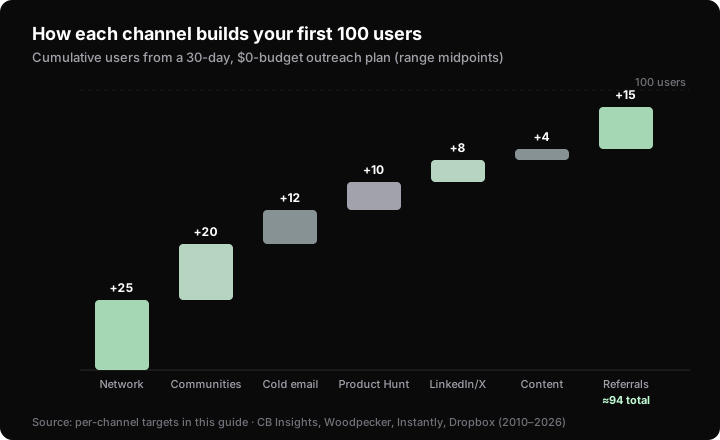
You probably won't hit 100 in 30 days. That's fine. The point is to learn which 1-2 channels produce your best users and double down. For a detailed growth playbook that takes you from here to $1M ARR, we break it down channel by channel.
If you're a founder who hates marketing entirely, our guide on organic user growth covers the minimum viable approach.
Frequently Asked Questions
How long does it take to get your first 100 users?
Most startups take 4-8 weeks to reach 100 users when using manual outreach channels. The timeline depends on your product's niche, how specific your target user is, and how much time you put into daily outreach. B2B products with a well-defined ICP tend to reach 100 faster through cold email and LinkedIn. B2C products often need community channels and referrals.
Should you pay for ads to get your first users?
No. Paid ads require you to already know your ideal customer profile, your messaging, and your conversion funnel. Before 100 users, you don't have enough data to know any of those. Spend your budget on a better product, not Facebook ads. Once you've validated your messaging with manual outreach, paid ads can accelerate what's already working.
What's the best single channel for getting first users?
Personal network outreach converts highest because you already have trust. Cold email scales better. Communities build long-term credibility. There's no universal "best" channel because it depends on your product and audience. The marketing 101 framework helps you decide which channel fits your stage.
How do you know when you've hit product-market fit?
Sean Ellis, who coined the term "growth hacking," suggested asking users: "How would you feel if you could no longer use this product?" If 40% or more say "very disappointed," you have product-market fit (Sean Ellis via PMF Survey, 2010). Below 40%, keep iterating.
Can you get your first 100 users without any technical skills?
Yes. Every channel in this guide works without coding. Personal outreach, community engagement, cold email, and Product Hunt launches are communication skills, not technical ones. Tools like Apollo.io, Hunter.io, and Mailchimp have free tiers that handle the technical parts. The bottleneck is your willingness to do manual, unglamorous work, not your tech stack.
Sources
- CB Insights. "The Top 12 Reasons Startups Fail." 2024 update, analysis of 431 failed VC-backed companies.
- Paul Graham. "Do Things That Don't Scale." July 2013.
- Search Engine Watch. "How Guest Posting Propelled One Site From 0 to 100,000 Customers." Leo Widrich interview, 2012.
- Woodpecker. "Cold Email Statistics." Analysis of 20M+ cold emails, 2026.
- Instantly. "Cold Email Benchmark Report 2026." Billions of email interactions analyzed.
- Drew Houston. "Dropbox Startup Lessons Learned." SlideShare, 2010.
- HubSpot. "Marketing Statistics." State of Marketing Report.
- Sean Ellis. "The Startup Pyramid." Product-market fit survey methodology, 2010.
- Y Combinator. "YC's Essential Startup Advice." Startup Library.