The median SaaS startup takes 2 years and 9 months to reach $1M ARR, according to ChartMogul's 2025 SaaS Growth Report. A founder in the micro-SaaS space did it in 9 months. Not with a single viral moment or a huge funding round. With volume across every channel, running simultaneously, until something compounded.
This isn't theory. It's a real breakdown, posted publicly on Reddit. Eight LinkedIn accounts. 6,500 cold emails per day. 5-8 demos daily. 50K organic visitors per month. One person running it all for 9 months.
What follows is a SaaS growth playbook built on real numbers, channel by channel, with benchmarks so you can measure this founder's results against industry averages.
Key Takeaways
- Median time to $1M ARR is 2 years 9 months; this founder did it in 9 months (ChartMogul, 2025)
- 70% demo close rate, vs 20-30% industry average, driven by tight lead qualification
- Cold email at 6,500/day generated ~130 replies daily at a 2% reply rate
- Running all channels simultaneously created compounding surface area
- The approach broke at scale: 18-hour days aren't a growth strategy
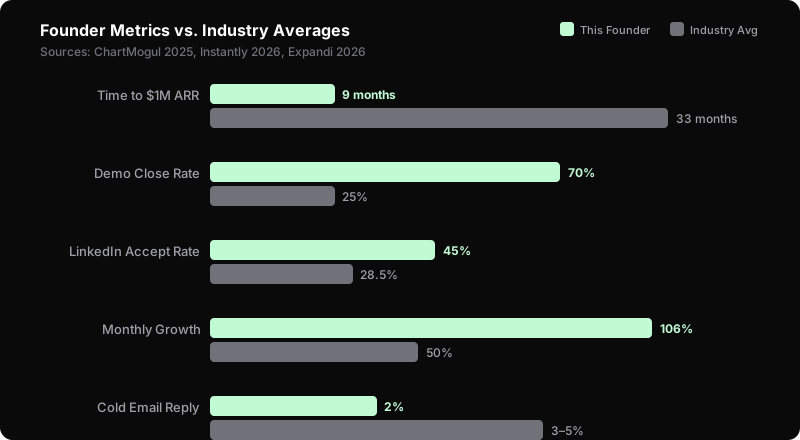
Founder Metrics vs. Industry Benchmarks
| Metric | This Founder | Industry Average | Source |
|---|---|---|---|
| Time to $1M ARR | 9 months | 2 years 9 months | ChartMogul 2025 |
| Cold email reply rate | 2% | 3-5% | Instantly 2026 |
| LinkedIn acceptance rate | ~45% (personalized) | 28.5% | Expandi 2026 |
| Demo close rate | 70% | 20-30% | ChartMogul 2026 |
| Monthly organic visitors | 50,000 | Varies | Ahrefs |
| Monthly growth rate (peak) | 106% | 50% median (sub-$1M) | ChartMogul 2024 |
What Does a $1M ARR Growth Stack Actually Look Like?
SaaS companies under $1M ARR grow at a median rate of 50% year-over-year, according to ChartMogul's October 2024 data. This founder hit 106% growth in a single month. The difference? He wasn't optimizing one channel. He was running five at once: outbound (LinkedIn + cold email), content (5 platforms), paid (3 channels), demos, and SEO.
Most founders pick one or two channels and go deep. That's smart advice for early-stage growth. But this playbook is what happens when someone with a working product decides to flood every channel with volume. Not every channel was efficient. Some were wasted effort. But the aggregate surface area meant leads came from everywhere.
Want to see which channels work at each stage? Our SaaS growth channels breakdown ranks free and paid options from $0 to $100K MRR.
LinkedIn Outreach: 600 Daily Touches Across 8 Accounts
LinkedIn connection requests average a 28.5% acceptance rate across the platform, according to Expandi's 2026 benchmark study of 13.2M data points. Personalized requests push that to 45%. This founder ran 8 LinkedIn accounts, sending 35 connection requests and 40 DMs per account, per day. That's 280 connection requests and 320 DMs going out daily.
The hook wasn't a pitch. It was a "blueprint," a high-value document relevant to the recipient's role. People respond to useful stuff. The demo booking came after they'd already gotten value from the resource.
The scale factor was self-referential. The founder used his own product to run this outreach. The SaaS finds high-intent leads and automates contact. This is dogfooding, but the effect goes beyond testing. It becomes a live case study you show prospects: "See this message that just reached you? Our product sent it."
The blueprint approach deserves a closer look. Every first touch delivered a standalone document. Not a pitch. Not a free trial. A growth teardown, a template library, or a competitive analysis. The recipient got value before they knew the product existed. By the time the demo ask came, the founder had already demonstrated competence. This is why the 45% personalized acceptance rate matters. Generic connection requests ("I'd love to connect!") get ignored. Value-first requests get accepted and replied to.
One automation detail worth stealing: a script automatically replied to LinkedIn comments with the requested resource. When someone commented asking for a blueprint, they got it immediately. This scaled content distribution without manual work per comment.
If you're running LinkedIn solo, you don't need 8 accounts. Start with one and a solid X/Twitter marketing system running alongside it. Two channels are enough early on. Or skip the public posting entirely and DM your ideal users directly.
Can Cold Email Still Work at 6,500 Sends Per Day?
The average cold email reply rate has dropped to 3-5% in 2026, down from 8.5% in 2019, according to Instantly's 2026 Cold Email Benchmark Report. This founder sent 6,500 emails per day at a 2% reply rate. That's roughly 130 replies daily from cold contacts who'd never heard of the product.
A 2% reply rate sounds low against the 3-5% average, but context matters. At 6,500 sends per day, even 2% generates massive pipeline. Most senders operate at 50-200 emails daily. Volume changes the math.
At this scale, deliverability becomes the bottleneck. You need clean lists, warmed domains, and rotating sending infrastructure. That means multiple sending domains (not your primary), each warmed for 2-4 weeks before hitting full volume. Most senders who try 6,500/day without this prep land in spam within 48 hours.
The first email captures 58% of replies, with follow-ups getting the remaining 42% (Instantly, 2026). Elite performers keep first-touch emails under 80 words. That's tight. No company backstory, no feature lists. Just: "I made this for people in your role. Want it?" Then the follow-up sequence does the heavier selling.
The offer was a blueprint, not a discount or free trial. Leading with value keeps reply rates up even as inbox saturation grows.
Nobody's solved cold email deliverability completely. But if you're going to try cold outreach, start with our cold email guide for templates that actually get responses. And if cold email feels too heavy, look into AI outbound tools that start with just your URL.

Five-Platform Content Strategy: LinkedIn, X, Reddit, YouTube, Threads
Authentic behind-the-scenes content outperforms polished brand posts on platforms like X, according to Buffer's 2024 State of Social Media report. This founder published across five platforms simultaneously: 8 LinkedIn posts per day, 3 X posts per day, 2 Reddit posts per week, daily YouTube videos, and Threads reposts. Volume created compounding inbound leads.
Content ran on LinkedIn, X (Twitter), Threads, Reddit, and YouTube simultaneously. That's a lot of surface area for one person, and it eventually broke (more on that below). But while it held up, content was the compounding engine behind inbound leads.
LinkedIn content
Eight posts per day, one per account. Six days per week focused on lead magnet content: posts designed to drive people to request a resource. One day per week was founder content, the story behind the company. This 6:1 split matters. Lead magnet posts generate direct pipeline. Founder content builds trust over time. Running both means you don't sacrifice one for the other.
X (Twitter)
Three posts per day across three accounts. The strategy was documentation over performance: what's being built, what's being learned. Buffer's 2024 State of Social Media report found authentic behind-the-scenes content outperforms polished brand content on X. This holds for accounts under 50K followers. If you're running X solo, one account and a consistent posting cadence is enough to start.
Two posts per week, focused on high-value content. Reddit punishes promotional content aggressively. Communities downvote or ban anything that reads like an ad. The strategy was posting useful, specific information, like the very growth breakdown this guide is based on. That generates genuine engagement and drives traffic without getting banned.
This is worth emphasizing. The original Reddit post that this guide is based on got massive engagement precisely because it was a no-BS breakdown with real numbers. No link to a landing page. No pitch. Just data. The traffic came from people clicking through to learn more about the product mentioned in the post. That's how Reddit marketing works: you earn attention by being useful, and the curious ones find you.
If Reddit's your channel, our Reddit marketing tactics guide covers 30 tactics that work. Or start smaller: learn how to get sales from Reddit without getting banned.
YouTube
The YouTube strategy was SEO-first: rank for competitor keywords. Someone searching for a competitor by name is already in the market. If your video shows up, you're reaching buyers at the moment they're evaluating options.
The founder posted one video per day, then scaled back to two per week. Quality dropped at daily cadence, a clear signal the channel wasn't sustainable at that pace solo.
For content marketing as a founder, you don't need five platforms. You need one or two that compound.
What Paid Channels Work at the $1M ARR Stage?
Retargeting ads achieve a click-through rate 10x higher than standard display ads (SQ Magazine, 2026). Average retargeting CTR sits at 0.7-1.2%, compared to 0.05-0.08% for programmatic display. This founder ran three paid channels, all relatively modest spend.
LinkedIn influencer posts
Three sponsored posts per week at ~$500 each. $1,500/week total. The founder handled everything: sourcing influencers, negotiation, writing the post, and final approval. Controlling the message matters on LinkedIn where influencer content quality varies wildly. Need to find the right influencers? Here's how to find influencer emails using Google scraping.
Retargeting
Facebook retargeting ran alongside an ad placement on TrustMRR, a platform for SaaS deal discovery. Retargeting campaigns deliver an average ROAS of 4.2x, up from 4.0x in 2024 (SQ Magazine, 2026). Retargeting people who visited but didn't convert is one of the highest-ROI ad strategies available at any budget.
Scaling plan
The stated plan was to scale paid ads aggressively. Take what's showing positive return and increase spend. Don't experiment with new channels. If retargeting and LinkedIn influencer posts convert, doubling those budgets is lower risk than launching something untested.

Why Do Demos Convert at 70% When the Industry Average Is 20%?
The median SaaS free-to-paid conversion rate is 8% across all products, according to ChartMogul's 2026 Conversion Report. Demo-to-opportunity conversion ranges 60-80% for average performers. This founder hit 70% close rate to the free plan from 5-8 demos per day. The audience was mostly sales teams.
Why so high? Tight targeting. By the time someone booked a demo, they'd already received a blueprint, engaged with content, and self-qualified. Only people who genuinely wanted the product made it to that stage. The outreach funnel acted as a filter, not a funnel.
The founder didn't enjoy demos. But at 70% conversion, skipping them would've been expensive. The bottleneck wasn't close rate. It was calendar space. Opening the calendar fully could yield 20 demos per day, but that's not sustainable solo.
What made this close rate possible is the funnel design. LinkedIn outreach and cold email pre-qualified leads with blueprints. Content built trust and familiarity. By the time someone booked a 15-minute demo, they already understood the product's value proposition. The demo wasn't discovery. It was confirmation. That's why 70% closed: the selling happened before the call started.
Most founders dodge this truth: if your product requires explanation, don't hide behind async content. Get on calls. A 70% conversion rate isn't magic. It's what happens when you talk to the right people and show them something that solves a real problem.
How Long Does SEO Take to Reach 50K Monthly Visitors?
Only 1.74% of newly published pages rank in the top 10 within one year, according to Ahrefs' ranking study (2025 update). This founder's site hit 50,000 visitors per month organically. SEO was the slowest channel to produce results, but by month 9, it was contributing meaningfully to demo bookings and free plan signups.
The process: an AI tool (Outrank) generated article drafts, then the founder edited and improved them before publishing. This hybrid approach is increasingly common. AI handles drafting speed. Humans handle judgment. Publishing AI drafts without editing produces thin, repetitive content that ranks poorly.
The competitor keyword strategy on YouTube mirrored the SEO approach: find where people are already searching for solutions and show up there. Targeting competitor keywords enters searches where commercial intent is already established.
SEO compounds, but it takes 6-12 months to show results. Start early. Publish, edit, repeat. Don't expect traffic in month two. For a different angle on building organic authority, our relationship-based link building guide covers what actually works when cold email outreach for links fails.
Where the Growth Machine Broke Down
Most SaaS startups that reach $1M ARR with a solo founder hit an operational ceiling. ChartMogul's 2025 report shows the median time to $1M ARR is 2 years 9 months, partly because sustainable pacing avoids burnout. This founder compressed that timeline into 9 months through 18-hour days, and the cracks showed across content quality and channel depth.
Honesty about what's not working is more useful than lists of wins. Here's the founder's own assessment.
What worked:
- Using the product to sell the product, which doubled as live proof and continuous testing.
- Organic traffic hitting 50K/month. Compounding. No additional spend required.
- Churn decreasing, a sign the product improved or customer fit tightened.
- Fast dev cycles.
- LinkedIn comment automation saving hours per day on content distribution.
What didn't work:
- One person across every channel. Unsustainable past month 6.
- 18-hour days. That's a ceiling, not a strategy.
- Reddit and YouTube quality slipping because depth takes time that volume doesn't leave you.
The solution: hiring an operator to manage execution so the founder could focus on strategy and decisions. At $1M ARR, the bottleneck shifts from "how do we grow" to "who executes the growth."
This is the part most growth breakdowns leave out. Every channel that works adds operational load. The founder was writing LinkedIn posts, recording YouTube videos, sending cold emails, running demos, editing blog posts, and managing paid ads. All solo. Something had to break, and quality was the first casualty.
Takeaways for Pre-Revenue Founders
This SaaS growth playbook doesn't map directly to a pre-revenue product. The budget, account infrastructure, and demo volume all assume you've already found something that works. But a few principles apply at any stage.
Lead with value, not pitches. Every outreach channel here used a blueprint as the hook. People respond to useful stuff. If your outreach starts with what you want, you'll get ignored.
Pick two or three channels and go deep. This founder ran at an intensity that's unsustainable solo. Starting with LinkedIn outreach plus one content channel is more manageable and still effective. See our 30 places to find your first 100 users for where to start.
Use your product to market your product. If your SaaS automates outreach, analyzes data, or improves writing, use it publicly. It's your best demo. The AI vibe marketing stack covers tools that help founders do exactly this.
Demos close. If your product needs explanation, get on calls. The 70% close rate in this playbook came from tight targeting, not sales tricks.
SEO takes 6-12 months. Start it early. Publish, edit, repeat. Don't expect traffic in month two.
Email was one of the highest-ROI channels in this playbook. For the full breakdown of tools, sequences, and segmentation tactics, see our email marketing guide for small business. Starting from zero? Pick one channel, go deep, and expand only after it works.
Frequently Asked Questions
How much does it cost to replicate this SaaS growth playbook?
The founder spent roughly $2,200 per week on paid channels: $1,500 on LinkedIn influencer posts, $500 on Facebook retargeting, and $200 on TrustMRR. The outbound tools (8 LinkedIn accounts, cold email infrastructure) add another $500-1,000/month. Total monthly spend was approximately $10,000-$13,000, excluding the founder's time. Most of the growth came from sweat equity, not ad spend.
What's a realistic timeline to reach $1M ARR for a bootstrapped SaaS?
The median SaaS startup takes 2 years and 9 months to reach $1M ARR, according to ChartMogul's 2025 report. The top 25% of bootstrapped SaaS companies reach it in 2 years, only 4 months slower than VC-backed startups. Nine months is exceptional and required unsustainable 18-hour days.
Is cold email still effective for SaaS in 2026?
Cold email reply rates have dropped to an average of 3-5% in 2026, down from 8.5% in 2019 (Instantly, 2026). It still works, but requires better targeting, cleaner lists, and shorter emails. Elite performers keep first-touch emails under 80 words and lead with value, not pitches.
Should founders do their own demos or hire a salesperson?
At a 70% close rate, the founder's demos were the highest-converting channel in the stack. The rule of thumb: do demos yourself until you can't keep up, then hire. This founder hit that ceiling at 5-8 demos per day. Once you understand your own sales process deeply enough to document it, you can hand it off without losing conversion quality.
How many marketing channels should an early-stage SaaS founder run?
Start with two or three channels maximum. This founder ran five content platforms, two outbound channels, three paid channels, and daily demos, but hit burnout and quality degradation. Pick your highest-converting channel, add one supporting channel, and go deep before expanding. Most first 100 users come from one or two channels, not ten.
Sources
- ChartMogul. "Against the Odds: The 2025 SaaS Growth Report." chartmogul.com/reports/saas-growth-the-odds-of-making-it. Accessed June 2026.
- ChartMogul. "The SaaS Conversion Report: A new look at free-to-paid conversion." chartmogul.com/reports/saas-conversion-report. Accessed June 2026.
- Instantly. "Cold Email Benchmark Report 2026." instantly.ai/cold-email-benchmark-report-2026. Accessed June 2026.
- Expandi. "LinkedIn Outreach Benchmarks 2026: 13.2M Data Points." expandi.io/blog/linkedin-outreach-benchmarks-2026. Accessed June 2026.
- Buffer. "2024 State of Social Media Report." buffer.com/resources/social-media-trends-2024. Accessed June 2026.
- Ahrefs. "How Long Does It Take to Rank in Google?" ahrefs.com/blog/how-long-does-it-take-to-rank-in-google. 2025 update. Accessed June 2026.
- SQ Magazine. "Retargeting Ad Performance Statistics 2026." sqmagazine.co.uk/retargeting-ad-performance-statistics. Accessed June 2026.
- Reddit. "r/micro_saas founder breakdown." reddit.com/r/micro_saas/comments/1r4vzpt. Original source.