Forty-seven percent of companies that saw the highest content marketing ROI repurposed content across three or more channels, according to Semrush's State of Content Marketing report. The companies that struggled most created original content per channel. That's the core insight for founders with no time: write once, distribute everywhere.
This guide is built for the founder who has 90 minutes on a Tuesday, a half-formed opinion about their industry, and a vague sense they should be doing something with LinkedIn. No content team. No editorial calendar managed by a full-time hire. Just a system that works in 2-3 hours per week.

Key Takeaways
- 47% of top-performing companies repurpose across 3+ channels; the worst create original content per channel (Semrush)
- 96.55% of pages get zero organic traffic from Google; target specific questions, not broad topics (Ahrefs)
- One LinkedIn post per week, repurposed to 3 other channels = 2-3 hours total
- Email subscribers are the one metric that matters in year one; 500 subscribers outweighs 10,000 LinkedIn followers
Why Do Most Founder Content Strategies Fail?
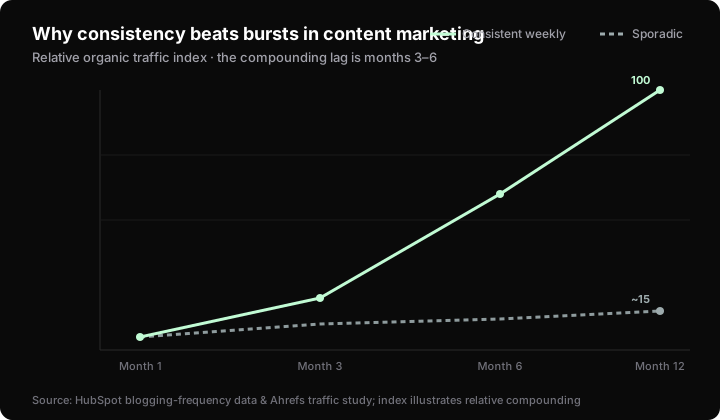
Content marketing takes 3-6 months to produce measurable organic traffic, yet 90% of all blog posts get zero traffic from Google, according to Ahrefs (analysis of 1 billion+ pages). Founders used to short feedback loops from ads or outreach quit during this lag, right before traction starts compounding. The failure isn't effort. It's systems.
Most founders read about content marketing, get excited, publish three blog posts in January, then disappear until Q3. The posts get no traffic. The strategy gets labeled a failure. The founder goes back to cold outreach.
This isn't a discipline problem. It's a systems problem. Most content advice is written for marketing teams with dedicated writers, editors, and SEO specialists. You have none of that.
Content marketing has a lag. Posts published today may not get traction for 3-6 months. Founders used to short feedback loops from ads or outreach often quit right before traction shows up. The fix isn't working harder. It's building a system so lightweight you can't quit, because it barely takes any time.
For a broader view of which growth channels work at each revenue stage, we rank all of them from $0 to $100K MRR. Content marketing sits in the "slow to start, hardest to stop" category.
What Should You Write About?
An Ahrefs study of over one billion web pages found that 96.55% get zero organic traffic because they target keywords nobody searches for. The fix for founders: write about problems you already understand from customer conversations rather than researching topics from scratch. Your direct experience is both faster to produce and more valuable to readers.
The biggest time sink in content creation is research. Stop researching topics you don't already know.
You have direct knowledge most content marketers would pay for. You know your customers' objections, the questions your sales calls always surface, the misconceptions your industry perpetuates, and the workarounds your users have hacked together.
That's your content inventory. Open a doc and answer these four prompts without editing yourself:
- What do most people get wrong about [your category]?
- What's the question every new customer asks before they sign up?
- What did you believe 18 months ago that you now know is wrong?
- What do you wish someone had told you when you started building this?
You'll have 8-12 raw content ideas in under 20 minutes. That's a month of posts at a sustainable pace.
If you want to validate which ideas have search demand before writing, use Ahrefs or Ubersuggest. Ahrefs' research shows that 96.55% of pages get zero organic traffic because they target keywords nobody searches for. Confirm someone is searching for the thing before you invest time in it.
How Does the One-Post-Many-Places Method Work?
Forty-seven percent of companies with the highest content marketing ROI repurposed content across three or more channels, while the lowest performers created original content per channel, according to Semrush's State of Content Marketing report. For solo founders, this means writing one piece and distributing it to 4-5 platforms, not creating separate content for each.

Publishing in one place and hoping is the slow road. The faster approach: write once, distribute everywhere your audience already spends time.
Start with a LinkedIn post (not a blog post). LinkedIn has built-in distribution, doesn't require SEO, and lets you test whether an idea resonates before you invest more time. A post that gets real engagement is telling you something.
From that one LinkedIn post, you can:
- Thread it on X by breaking it into smaller claims. Our X marketing system covers how to build a repeatable posting process.
- Paste it into your email newsletter with a short intro paragraph added
- Expand the highest-performing section into a blog post for SEO
- Post a version to relevant subreddits. Our Reddit marketing guide covers how to do this without getting banned.
- Use the comments and replies as research for a follow-up piece
The upfront writing cost is the same. The distribution is 4-5x larger.
You can also skip the blog entirely at first and rank on Google using Medium if you don't have a website yet. Medium's domain authority means your posts index faster.
What's the Minimum Viable Publishing Schedule?
Companies that blog consistently one to four times per month see 3.5x more traffic than those that publish less than once per month, according to HubSpot's marketing benchmark data. Consistency matters more than volume. A steady weekly cadence builds domain authority and audience trust faster than sporadic publishing bursts followed by months of silence.
One post per week is enough. Two is better. Five is a full-time job you don't have.
The goal in year one is consistency over volume. A steady cadence of weekly content builds domain authority, audience trust, and search rankings faster than sporadic bursts of five posts followed by months of silence.
Here's a realistic schedule for a solo founder:
| Day | Task | Time |
|---|---|---|
| Monday | Write a LinkedIn post based on something that happened last week. One observation, one example, one takeaway. Under 200 words. | 30 min |
| Wednesday | Reply to every comment on Monday's post. Engagement tells the algorithm your content is worth distributing. | 15 min |
| Biweekly | If Monday's post got traction, expand it into a 600-900 word blog post. This doubles as SEO fuel over time. | 60-90 min |
Total: 2-3 hours per week. That's manageable alongside everything else you're doing.
How Do You Write Faster Without Writing Worse?
Writers who use fill-in-the-blank templates produce first drafts faster than those starting from a blank page. Templates eliminate the decision fatigue of choosing a format and let you focus on the one thing that matters: sharing a specific insight backed by a real example.
The blank page is your enemy. Remove it with a fill-in-the-blank template:
[Counterintuitive claim].

Here's what I mean:

[Short story or example from your work]

What this taught me: [Specific takeaway]
Example:
Talking to 10 customers beats publishing 10 blog posts.
Last month, I almost hired a content writer. Instead, I ran 10 customer calls. Three surfaced the exact language our landing page was missing. We changed two headlines and conversion went up 18%.
Customer language is your best copy. Go find it.
This post took 8 minutes to write. It's personal, specific, and teaches something. That's the formula.
For blog posts, use the same structure at longer length: one claim, supporting story, evidence, specific takeaway. A focused 700-word post that actually answers a question outperforms a bloated guide nobody finishes.
You can also use copy-ready prompts to scan Reddit and X for what your audience is already talking about. Those conversations become your content topics without any brainstorming sessions.
How Do You Handle SEO Without Becoming an SEO Person?
Keywords with 100-1,000 monthly searches have significantly lower competition and higher conversion intent than high-volume terms, according to Ahrefs keyword difficulty data. For new domains, targeting these long-tail queries is the fastest path to ranking. The simplest keyword research method: ask your last five customers what they Googled before finding your product.

You don't need to become an SEO specialist. You need one concept: people type questions into Google, and if your page answers that question better than what's currently ranking, you'll eventually get traffic.
The shortcut for founders: write about what your customers Googled before they found you.
Ask your last five customers: "What did you search for right before you found us, or before you started looking for a solution like ours?" Their answers are your keyword list.
Then check whether those searches have volume. Aim for keywords with 100-1,000 monthly searches in the early days. High-volume keywords are dominated by companies with years of domain authority. Low-competition, specific queries are where new domains can actually rank.
For link building to strengthen your domain authority over time, relationship-based approaches work better than spray-and-pray outreach.
What Should You Do With Old Content That Gets No Traffic?
Updating and republishing old blog posts with fresh data and improved structure can increase organic traffic to those pages by 106%, according to HubSpot's historical optimization experiments. Refreshing underperforming content is often faster and more effective than writing from scratch because Google recrawls updated pages with fresh signals.
Most sites have a graveyard of posts from two years ago that nobody reads. Before publishing anything new, run a quick audit.
Open Google Search Console (free), filter by pages, and sort by impressions. Find posts that show up in search but get no clicks. That's a title or meta description problem. Find posts that get clicks but don't rank. That's a content quality issue.
Updating old content is often faster than writing new content and can have a bigger impact. Google indexes the updated date and may recrawl the page with fresh signals. A 90-minute session updating three underperforming posts beats three new posts from scratch.
This is exactly what we're doing with our own guides on this site. The SaaS growth playbook started at 1,400 words and didn't rank. After expanding to 2,800 words with sourced data and internal links, it became one of our strongest pages.
What's the One Metric That Matters in Year One?
Email marketing delivers an average return of $36 for every $1 spent, the highest ROI of any marketing channel, according to Litmus (2024). Unlike social followers or page views, email subscribers are an owned audience that survives algorithm changes and platform shifts. In year one, 500 engaged subscribers outweigh 10,000 LinkedIn followers.
Email subscribers. Not LinkedIn followers. Not page views. Not shares.
Social platforms change algorithms. Google updates core rankings. Email is the one channel you own. If you build an audience of 500 people who asked to hear from you, that's an asset that survives every platform change.
Set up a simple email capture on your blog. Use ConvertKit or Beehiiv. Send one email per week. It can literally be your best LinkedIn post from that week with two sentences of context added.
Our email marketing guide covers the full system: welcome sequences, segmentation, and the automated flows that turn subscribers into paying customers.
In 12 months, 500 subscribers who trust you is worth more to your business than 10,000 LinkedIn followers who scrolled past your post once.
What Mistakes Should You Avoid?
Content marketing has a documented 3-6 month lag between publishing and traction, and 60-70% of marketing content goes completely unused after creation, according to Content Marketing Institute research. The most common founder mistake isn't producing bad content. It's quitting in month two before the compounding effect starts, then wasting effort creating new pieces instead of distributing what exists.
Publishing without a call to action. Every post should ask one thing: subscribe, reply, book a call, read another post. One ask. Readers won't act without direction.
Targeting your peers instead of your customers. Founders often write content that impresses other founders. Unless other founders are your customers, this is brand-building theater. Write for the person who would pay you.
Giving up in month two. Set a 6-month commitment, then evaluate. Content marketing has a 3-6 month lag between publishing and traction.
Optimizing for length instead of clarity. A 400-word post that answers one question clearly beats a 2,000-word post that answers five questions badly.
A Simple System You Can Start This Week
- Write down 10 things you know about your industry that most people get wrong.
- Turn the best one into a LinkedIn post this week.
- Set up a free Beehiiv or ConvertKit account. Link to it from your LinkedIn profile.
- Check Google Search Console for any existing pages with impressions but no clicks. Fix their titles.
- In four weeks, review what got engagement. Write more of that.
That's it. You're doing content marketing. If you want to see what else works alongside content, our 14 SaaS marketing hacks covers the full tactical menu for founders running lean. And for the broader user acquisition playbook, start with how to get your first 100 users.
Frequently Asked Questions
How long does it take for content marketing to show results?
Most founders see meaningful organic traffic from content after 3-6 months of consistent weekly publishing. Social distribution (LinkedIn, X, Reddit) can produce results within days or weeks. The compound effect accelerates in months 6-12 as older posts accumulate search authority and backlinks. Set a 6-month commitment before evaluating ROI.
Should founders write their own content or hire a writer?
Write it yourself for the first 3-6 months. Your direct experience with customers and your product gives you insights no hired writer has. Once you've established your voice and know which topics resonate, you can hand off execution to a writer and focus on providing the raw material: customer stories, data, and contrarian opinions.
What content format works best for SaaS founders?
LinkedIn posts (under 200 words) for testing ideas and building audience. Blog posts (600-1,500 words) for SEO. Email newsletters for retention. The format matters less than the insight. One strong opinion backed by a specific example beats a perfectly formatted but generic article every time.
How do you come up with content ideas consistently?
Three reliable sources: (1) questions from customer conversations and support tickets, (2) topics your audience is already discussing on Reddit and X (use our copy-ready prompts to scan), and (3) your own changing opinions about your industry. The "what did you believe 18 months ago that's now wrong" prompt alone generates 3-4 strong pieces.
Is blogging still worth it in 2026 with AI search?
Yes, but the bar is higher. Generic content won't rank or get cited by AI systems. Content with original data, first-hand experience, and specific examples gets both Google rankings and AI citations. The founder advantage is real: you have experiences and customer insights that AI can't fabricate. That's your moat.
Sources
- Semrush. "State of Content Marketing Report." 47% of top performers repurpose across 3+ channels.
- Ahrefs. "Search Traffic Study." 96.55% of pages get zero organic traffic, analysis of 1 billion+ pages.
- Instantly. "Cold Email Benchmark Report 2026." Campaign size vs reply rate data.
- CB Insights. "Top Reasons Startups Fail." 2024 update.
- Google. "Search Console." Free page performance and indexing data.