By Pablo Bravo
Most marketing channels bleed money before they pay you back. Paid ads cost more each quarter. Social reach keeps shrinking. Yet email quietly returns $36-42 for every $1 spent, according to Litmus's 2025 State of Email Report. The top 18% of programs earn $70+ per dollar.
If you're a bootstrapped founder doing your own marketing, email isn't just another channel. It's the one channel you actually own. No algorithm decides who sees your message. No platform takes a 30% cut. You write something, hit send, it lands in someone's inbox.
This guide covers everything from picking your first tool (for free) to building automated sequences that sell while you sleep. Written for founders at every stage, from pre-revenue to $100K MRR. No generic advice. No filler. Just what works.
New to marketing entirely? Start with our marketing 101 framework first.
Key Takeaways
- Email marketing returns $36-42 for every $1 spent (Litmus, 2025)
- Start with 3 automated sequences: welcome, nurture, re-engagement
- Automated emails earn $2.87 per send vs $0.18 for manual campaigns (Omnisend, 2025)
- Free tools handle everything until 2,500+ subscribers
- Gmail and Yahoo now require DMARC authentication for bulk senders
Why Does Email Marketing Still Beat Every Other Channel in 2026?
Litmus's 2025 State of Email Report found email earns $36-42 per $1 spent. That crushes paid search ($2 return), social ads ($2.80 return), and display ads ($1.35 return). Retail and e-commerce brands see even higher returns — $45 per $1. For bootstrapped founders with zero ad budget, no other channel comes close.
Chase Dimond, an email strategist who's generated $150M+ in email revenue for e-commerce brands, puts it bluntly: "Email is the only channel where you control the distribution." Your Instagram could get shadowbanned tomorrow. Your Google rankings can vanish after a core update. Your email list? That's yours.

Here's what makes email different for small businesses specifically. The cost is nearly zero at small scale. The targeting is precise. The results compound over time.
A social media post reaches maybe 5% of your followers. An email reaches 99% of your list. Mailchimp's 2025 benchmarks show average open rates between 35-45% across industries — though Apple's Mail Privacy Protection inflates those numbers. Click-through rate (1.9-3.4%) is the more reliable engagement signal now.
There's a revenue advantage too. Omnisend's 2025 data shows automated emails earn $2.87 per send compared to $0.18 for manual campaigns. That's 16x more revenue per email. Automated flows drive 30% of total email revenue while representing just 2% of send volume.
Curious how email compares to other SaaS growth channels? The data favors email at every stage.
How Do You Choose the Right Email Platform (Without Overpaying)?
Free tiers from MailerLite, Brevo, Kit, and Beehiiv now handle automations, landing pages, and A/B testing for up to 10,000 subscribers at zero cost. MailerLite consistently ranks as the best all-rounder for bootstrapped founders, according to Emailtooltester's 2025 platform comparison. You don't need a paid plan until you pass 2,500 subscribers.
Most founders overspend on email tools from day one. You don't need a $99/month platform when you have 200 subscribers. Four platforms offer genuinely free tiers that handle everything a bootstrapped founder needs.
Noah Kagan, AppSumo's CEO who grew his list to 700K+ subscribers, wrote in Million Dollar Weekend that he started with the cheapest tool available. "Don't optimize your email platform. Optimize your offer."
Here's an honest comparison for 2026. Not what sales pages say. What you'll actually experience.
Free Tier Comparison
| Feature | MailerLite | Brevo | Kit (ConvertKit) | Beehiiv |
|---|---|---|---|---|
| Subscriber limit | 1,000 | Unlimited | 10,000 | 2,500 |
| Send limit | 12,000/month | 300/day (~9,000/month) | Unlimited | Unlimited |
| Automations | Yes | Yes | Limited | No |
| Landing pages | Yes (10) | No | Yes (unlimited) | Yes |
| A/B testing | Yes | Yes | No | No |
| Newsletter monetization | No | No | No | Yes (ad network) |
| Best for | All-rounder | High-volume senders | Creators | Newsletter-first |
Which One Should You Pick?
Pre-revenue (0-100 subscribers): Pick MailerLite. Most generous free tier with the most features. Automations, landing pages, A/B testing — all free.
Newsletter-first creators: Pick Beehiiv. Free up to 2,500 subscribers with unlimited sends. Built-in recommendation network helps you grow. But you lose automations until the $89/month Scale plan.
Large free list needed: Pick Kit. Free up to 10,000 subscribers. Best if you're a content creator building a massive audience. Fewer features than MailerLite on the free tier.
High-volume transactional + marketing: Pick Brevo. Unlimited contacts, but capped at 300 sends/day. Works if you need both marketing and transactional email from one platform.
One thing that doesn't get mentioned enough: deliverability varies by platform. A cheap tool with bad deliverability costs more than an expensive tool that reaches inboxes. MailerLite and Kit both maintain strong sender reputations. Brevo's shared IP can be hit or miss at lower volumes.
Don't sign an annual contract until you've sent at least 20 campaigns. You won't know what features matter until you've used the tool for a few months.
This same "start free, upgrade later" principle applies to the 3-phase growth sequence for early founders.
How Do You Build an Email List from Zero?
List building comes down to two things: having something worth trading for an email address, and putting that trade in front of the right people. In 2023, Campaign Monitor data shows personalized opt-in offers convert 26% better than generic "subscribe to our newsletter" boxes.
Noah Kagan describes his approach through what he calls the "coffee challenge": talk to real people first, understand what they need, then create an opt-in that solves that specific problem.
Pre-Revenue: Your First 100 Subscribers
Forget pop-ups and landing pages. You don't have enough traffic for those to matter yet.
Direct outreach. Email 10 people you know who fit your target audience. Ask if they'd find a weekly email on your topic useful. This sounds unscalable. It is. That's the point. Your first 100 subscribers should be people you could have a conversation with.
Social bio links. Put your opt-in link in every bio. Twitter, LinkedIn, Reddit. Everywhere. Use a landing page with one sentence: what they'll get and how often.
Community participation. Answer questions on Reddit, Indie Hackers, or niche forums. Don't drop links. Be genuinely helpful. Put your landing page in your profile.
Early Revenue ($1K-$10K MRR): Scaling to 1,000
Content upgrades. Write a blog post. Create a bonus resource that goes deeper on that topic. Gate it behind an email opt-in. This converts 3-5x better than a generic lead magnet.
Exit-intent pop-ups. They're annoying. They work. Set them to trigger only once per visitor, only on blog posts, after 30 seconds on page.
Webinars and workshops. A 30-minute live session on a specific problem collects emails and builds trust simultaneously.
Growth Stage ($10K+ MRR): Compounding to 10,000+
Referral programs. Ask existing subscribers to forward your best emails. Add a "know someone who'd find this useful?" line at the bottom.
Co-registration partnerships. Find non-competing businesses serving the same audience. Cross-promote each other's lists.

What about buying lists? Don't. Ever. Purchased lists destroy your sender reputation, violate CAN-SPAM, and convert at near-zero rates.
Reddit is one of the best places to build early traction. Here's how to get sales from Reddit without getting banned.
What Should Your Welcome Sequence Look Like?
Omnisend's 2025 data found that welcome flows generate $2.65 per email on average — and the top 10% of welcome sequences earn $21.18 per email. Your welcome sequence does more selling than any launch campaign you'll ever run.
Amy Porterfield, who built a $100M+ business through her 300K+ email list, says her welcome sequence outperforms every launch. "That first week is when someone cares most. If you waste it with a generic 'thanks for subscribing' email, you've lost them."
The 5-Email Welcome Sequence (10 Days)
Email 1 (Immediately after signup): Deliver whatever you promised. Lead magnet, discount code, free resource. One sentence about who you are. One CTA.
Email 2 (Day 2): Your origin story. Why you started this business. Keep it under 300 words. End with a question that invites a reply.
Email 3 (Day 4): Your best piece of content. Blog post, video, guide — whatever gets the most positive response. Frame it as "this is what our readers find most useful."
Email 4 (Day 7): A specific tip they can use today. Something actionable in under 5 minutes. This builds trust through results.
Email 5 (Day 10): Soft pitch. "Here's what we offer and who it's for. If that's you, here's how to get started. If not, no worries — the free content keeps coming."

Does this feel like a lot? It shouldn't. You're writing 5 emails. Most are under 200 words. You can draft all of them in a single afternoon and never touch them again for months.
Building your first email list? Here's how to get your first 100 users across all channels.
What Makes a Small Business Email Actually Get Opened?
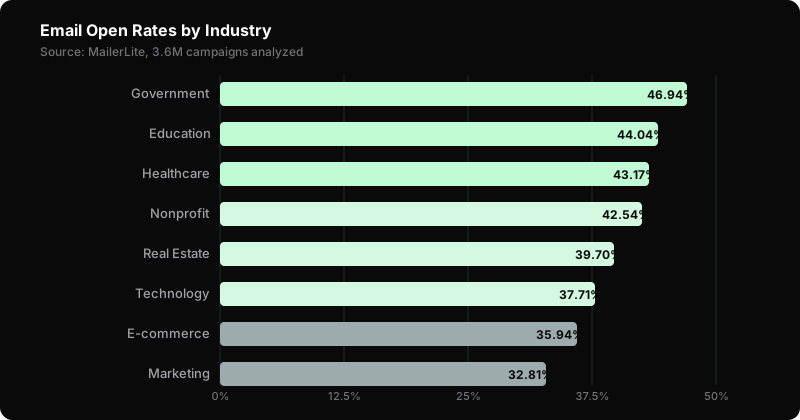
Personalized subject lines increase open rates by 26%, according to Campaign Monitor. And GetResponse's 2024 benchmarks found that Tuesdays at 10 AM local time consistently produce the highest open rates. But the real story goes deeper than "add their first name."
Joanna Wiebe, founder of Copyhackers, says subject lines should "complete the reader's thought, not interrupt it." Don't be clever. Be relevant.
Subject Line Formulas That Work
The specific number: "3 ways to reduce churn this week" beats "Tips for reducing churn." Always.
The curiosity gap: "The email mistake costing you subscribers." Not clickbait. Just enough tension to earn the open.
The plain-language question: "Are you making this pricing mistake?" Works because it mirrors how people actually think.
The result: "How we got 47 signups from one email." Specificity signals real data, not theory.
What Fails
"HUGE ANNOUNCEMENT" — all caps triggers spam filters and reader skepticism. "Newsletter #47" — nobody wants a newsletter, they want the thing inside it. "Quick update" — too vague, sounds not worth opening.
Beyond the Subject Line
Sender name matters more than people think. Use a real person's name, not your company name. "Pablo from MarketingIdeas" outperforms "MarketingIdeas Team" every time.
Preview text is your second headline. Most email clients show 40-90 characters of preview text. Don't waste it with "View this email in your browser."
Consistency builds open habits. Send at the same day and time each week. Your subscribers will start expecting your email.
Content marketing for founders drives the traffic that fills your email list.
How Do You Automate Without Losing Personality?
Automated emails generate 30% of total email revenue while representing just 2% of send volume (Omnisend, 2025). That's the upside. The downside: bad automation feels robotic and kills engagement. The trick is building systems that respond to behavior, not just schedules.
Beyond the Welcome Sequence: Nurture and Re-engagement
After your welcome sequence ends, subscribers move into your nurture flow. One email per week. Alternate between three types: a useful tip, a customer story, and a curated roundup. No 47-step content matrix needed.
When someone hasn't opened an email in 90 days, trigger a re-engagement sequence:
- Email 1: "Still interested?" Short email, simple subject line.
- Email 2 (5 days later): Share your single best resource.
- Email 3 (5 days later): "We'll remove you in 48 hours unless you click here." Sounds harsh. Works. Keeps your list clean.
Segment by Behavior, Not Just Demographics
Campaign Monitor found segmented campaigns drive 760% more revenue than unsegmented blasts. You don't need enterprise software for this. Three segments cover 90% of what a small business needs.
New vs. established subscribers. Anyone who joined in the last 30 days gets education and trust-building. Established subscribers get offers.
Engaged vs. dormant. Split by opens in the last 60 days. Engaged subscribers get your full schedule. Dormant subscribers get re-engagement.
By acquisition source. Someone from a blog post about pricing has different interests than someone from a webinar. Tag subscribers by source. Send matching content.
Use AI as a Speed Tool, Not a Replacement
AI adoption in email marketing has passed 60% among marketers, with AI-powered campaigns driving roughly 41% higher revenue (Omnisend, 2025). But full campaigns written by AI read like AI. Your subscribers will notice.
Use AI to generate 10 subject line variants. Pick the 2 that sound most natural. A/B test them. Use AI for drafts. Rewrite in your voice. The founders getting results use AI as a speed tool — write faster, test more, analyze quicker — while keeping their voice.
For cold outreach automation, check out our cold email guide that gets replies.
What Are the 4 Email Metrics That Actually Predict Revenue?
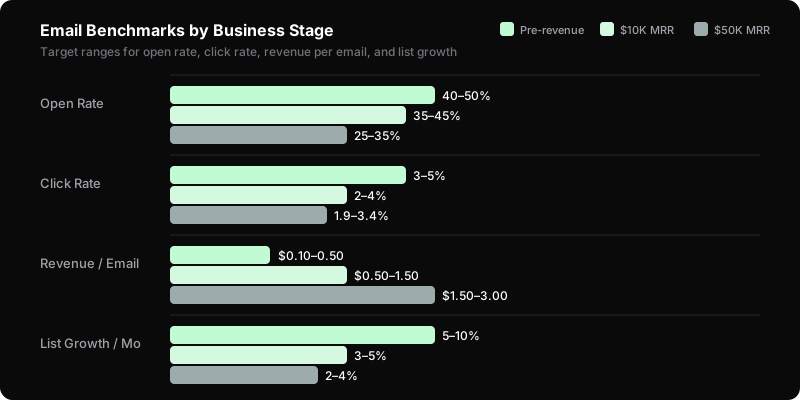
Four metrics predict email revenue: open rate, click rate, revenue per email, and list growth rate. Mailchimp's 2025 benchmarks report average open rates between 35-45% across industries, though Apple's Mail Privacy Protection inflates those numbers significantly. Click-through rate (1.9-3.4%) is now the more reliable engagement signal.
Open rate tells you if subject lines and sender reputation work. It's imperfect — Apple MPP inflates it — but still directionally useful.
Click rate tells you if content is relevant and CTAs are clear. More reliable than open rate. Target 2-5% for promotional emails, 5-10% for content emails.
Revenue per email is the metric that actually matters. Divide total email revenue by total emails sent. If you're making $0.50 per email to 1,000 subscribers four times a month, that's $2,000/month from email. Track this monthly.
List growth rate tells you if list building outpaces unsubscribes. Calculate: (new subscribers minus unsubscribes) divided by total list size. Healthy is 3-5% monthly net growth.
Metrics to Ignore
Unsubscribe rate gets too much attention. A 0.5% rate per email is normal. People who unsubscribe weren't going to buy anyway.
Spam complaints matter only above 0.1%. Below that, don't panic. Above it, check your opt-in process and frequency. (Gmail now enforces this — more on that below.)
See how email fits into the full growth playbook to $1M ARR.
How Do You Avoid the Spam Folder in 2026?
Gmail and Yahoo now require SPF, DKIM, and DMARC authentication for anyone sending 5,000+ messages per day, with permanent rejection for non-compliant senders since November 2025 (Google Sender Guidelines, 2025). Senders who exceed a 0.3% spam complaint rate face throttling or outright blocking.
In February 2024, Gmail and Yahoo rolled out new bulk sender requirements that changed email deliverability rules permanently. If you send 5,000+ messages per day to Gmail or Yahoo users, you must comply — or your emails won't arrive. Since November 2025, Gmail has escalated enforcement with permanent rejections for non-compliant senders.
The 4 Non-Negotiable Requirements
1. Authenticate with SPF + DKIM. These protocols prove you're authorized to send from your domain. Every major email platform (MailerLite, Kit, Brevo, Beehiiv) handles this setup — you just need to add DNS records. Takes 10 minutes.
2. Publish a DMARC record. At minimum, set p=none. This tells inbox providers you're a legitimate sender. Add a single TXT record to your DNS: v=DMARC1; p=none; rua=mailto:[email protected]
3. One-click unsubscribe. Marketing emails must include a List-Unsubscribe header that lets recipients unsubscribe in one click. All four platforms mentioned above handle this automatically. Don't hide unsubscribe links.
4. Keep spam rate below 0.3%. Target under 0.1%. Gmail tracks this through Postmaster Tools. Above 0.3% and your emails get throttled or rejected.
Domain Warm-Up for New Senders
If you're sending from a brand-new domain, don't blast your full list on day one. Start with 50-100 emails to your most engaged subscribers. Increase volume by 25% every few days. This builds sender reputation gradually.
Quick Deliverability Checklist
- SPF and DKIM records configured
- DMARC record published (even
p=nonecounts) - One-click unsubscribe in every marketing email
- Spam rate monitored in Google Postmaster Tools
- No purchased lists (ever)
- Re-engagement sequence for inactive subscribers
- Consistent "From" name and address
Having email deliverability issues? That's a deeper problem worth understanding.
Frequently Asked Questions
How often should a small business send emails?
Once per week works for most small businesses. Less frequent and subscribers forget you. More frequent and you risk fatigue. Noah Kagan sends twice per week with 700K+ subscribers, but he has years of content depth. Start weekly. Increase only if unsubscribe rate stays under 0.5% per send.
What's a good open rate for small business email?
Mailchimp's 2025 benchmarks show 35-45% average open rates, though Apple's Mail Privacy Protection inflates these numbers. Click-through rate (1.9-3.4%) is now the more reliable metric. If your click rate drops below 1.5%, check your content relevance and subject lines.
How many subscribers do you need before email marketing works?
You can generate revenue from email with 100 engaged subscribers. The math: 100 subscribers, 5% click rate, 10% purchase rate on a $50 product = $25 per email sent. Not life-changing, but profitable from day one. List size matters less than list quality and email automation.
Is email marketing still worth it in 2026?
Litmus's 2025 State of Email Report shows $36-42 ROI per $1 spent. The top 18% of programs earn $70+ per dollar. No other marketing channel offers this combination of reach, control, and profitability. Social platforms rise and fall. Email hasn't stopped growing since 1971.
What's the best free email marketing tool for beginners?
MailerLite wins for most beginners — 1,000 subscribers, automations, landing pages, and A/B testing for free. Beehiiv is better for newsletter-first creators (2,500 subscribers free, unlimited sends). Kit works if you need a huge free list (10,000 subscribers). Brevo fits high-volume senders who need unlimited contacts.
The Bottom Line
Email marketing isn't glamorous. It doesn't go viral. Nobody's posting screenshots of their open rates on Twitter.
But it works. Reliably. Measurably. Profitably.
Start with one free tool. Write a 5-email welcome sequence. Send one useful email per week. Segment when you hit 500 subscribers. Set up SPF, DKIM, and DMARC before your first send. Track four metrics. That's the whole playbook for your first year.
The math: email returns $36-42 per $1 spent (Litmus, 2025). Automated emails earn 16x more than manual campaigns (Omnisend, 2025). Segmented campaigns generate 760% more revenue (Campaign Monitor).
You already have the data. You already have the tools (for free). The only thing left is to start sending.
Continue Learning
Growth Tactics:
- How to Get Your First 100 Users
- SaaS Growth Playbook to $1M ARR
- SaaS Growth Channels: Free & Paid, $0 to $100K MRR
Related Channels:
Fundamentals:
Sources
- Litmus, "State of Email Reports 2025," retrieved 2026-06-29, https://www.litmus.com/state-of-email-reports
- Mailchimp, "Email Marketing Benchmarks," retrieved 2026-06-29, https://mailchimp.com/resources/email-marketing-benchmarks/
- Omnisend, "Email Marketing Statistics," retrieved 2026-06-29, https://www.omnisend.com/blog/email-marketing-statistics/
- Campaign Monitor, "Email Marketing Benchmarks," retrieved 2026-06-29, https://www.campaignmonitor.com/resources/guides/email-marketing-benchmarks/
- GetResponse, "Email Marketing Benchmarks," retrieved 2026-06-29, https://www.getresponse.com/resources/reports/email-marketing-benchmarks
- Google, "Email Sender Guidelines," retrieved 2026-06-29, https://support.google.com/a/answer/81126?hl=en
- Chase Dimond, retrieved 2026-06-29, https://chasedimond.com/
- Amy Porterfield, retrieved 2026-06-29, https://www.amyporterfield.com/
- Joanna Wiebe, Copyhackers, retrieved 2026-06-29, https://copyhackers.com/
- Noah Kagan, Million Dollar Weekend, retrieved 2026-06-29, https://noahkagan.com/million-dollar-weekend/
- Beehiiv, "Pricing," retrieved 2026-06-29, https://www.beehiiv.com/pricing
- MailerLite, "Email Marketing Benchmarks," retrieved 2026-06-30, https://www.mailerlite.com/blog/compare-your-email-performance-metrics-industry-benchmarks