Forty-three percent of startups fail because there's no product-market fit, according to CB Insights' analysis of 431 failed startups. But plenty of startups with solid products fail too, because nobody ever heard of them. Marketing isn't optional. It's survival.
These 14 tactics are specific, low-cost, and built for founders running lean. No team required. No ad budget needed. Pick two or three, run them for 60 days, and measure what happens.

Key Takeaways
- 96.55% of web pages get zero organic traffic from Google; the winners answer specific questions (Ahrefs)
- Personalized cold emails boost reply rates up to 142% vs generic sends (Woodpecker, 2026)
- Dropbox's two-sided referral program drove 3,900% user growth in 15 months (Drew Houston)
- Don't do all 14; pick 2-3 that match your stage and run them for 60 days
1. Build in Public on X
Founders who share transparent progress updates on X generate 2-3x more engagement than polished brand announcements, according to Buffer's social media engagement data (2025). Build-in-public posts work because audiences trust process over polish, and the format attracts early adopters who want to follow a product's evolution firsthand.
Document your journey: what you're building, what you've learned, what failed. Founders who share their process attract early users organically because people root for builders.
How to start: Post once a day about a real decision you made. Revenue milestones, user feedback, a bug that cost you three days. Keep it honest.
The key is engagement, not broadcasting. Reply to other founders, join conversations, and DM your ideal users when you see them tweeting about the problem you solve. Our full X marketing system covers how to turn this into a repeatable process.
2. Launch on Product Hunt (But Prepare First)
A 2024 survey of Product Hunt launchers found that nearly half attracted 500-2,000 visitors on launch day, with featured products regularly pulling 1,000-5,000 visitors (MySignature.io, 2024). But only about 10% of launches now earn featured status.
Preparation that matters:
- Build a hunter relationship or post it yourself (hunting yourself is fine now)
- Tell existing users the day before so they can upvote early
- Write a first comment explaining the problem you solve, not a press release
- Be active in comments on launch day. Responsiveness is a ranking signal
3. Get Into Newsletters Your Customers Read
Email newsletters deliver an average return of $36 for every $1 spent, making them the highest-ROI marketing channel available, according to Litmus (2024). A single mention in a niche newsletter with 10,000 engaged subscribers often outperforms paid ads on platforms with millions of passive users, because newsletter readers actively chose to be there.
Niche newsletters have tight audiences. A mention in a newsletter with 10,000 engaged subscribers often outperforms an ad on a platform with millions of passive scrollers.
Find newsletters by searching "[your target audience] newsletter" on Substack and Beehiiv. Sponsorship rates for smaller newsletters run $50-$300 per send, far cheaper than Google Ads for B2B.
Reach out directly with a concrete offer: a free trial code for their readers, a sponsored spot, or a co-promotion. Start with newsletters under 5,000 subscribers. They're more responsive and the audience is more engaged.
4. Cold Email With a Very Specific Offer
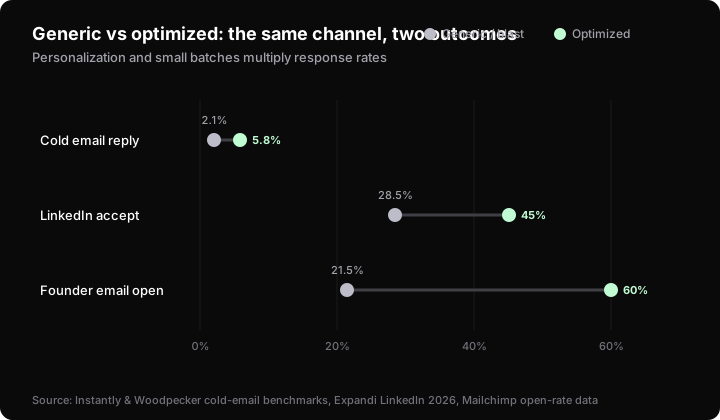
Highly personalized cold emails increase reply rates by up to 142% compared to generic sends, based on Woodpecker's analysis of 20 million+ cold emails (2026). Campaigns sent to fewer than 50 recipients average a 5.8% reply rate versus 2.1% for large blasts (Instantly, 2026). Specificity and small batch size are the two variables that determine cold email success.
Generic cold email is dead. Specific cold email works. Woodpecker's analysis of 20 million+ cold emails found that highly personalized messages increase reply rates by up to 142% (Woodpecker, 2026).
Rather than "Hi, I'd love to show you our product," try: "I noticed you're running three separate tools to do what [Product] does in one. Here's a free trial and a 15-minute setup if you want to try it."
Keep your list small. Campaigns under 50 recipients average a 5.8% reply rate vs 2.1% for large sends (Instantly, 2026). Spend 80% of your effort on the first sentence.
Our cold email guide has four templates you can adapt. For finding contact info, Google scraping techniques work without paid tools.
5. Find Where Your Customers Already Hang Out
Seventy-six percent of internet users participate in online communities, according to Global Web Index (2024). Community-first marketing works because trust already exists among members, and a genuine answer to a real question carries more weight than any paid ad placement.

Reddit, Slack communities, Discord servers, Facebook groups, LinkedIn groups. These are full of people talking about the exact problems your product solves.
Don't spam them. Read for a week first. Answer questions. Be useful. Only mention your product when it's genuinely relevant.
For Reddit specifically, our Reddit marketing guide covers how to promote without getting banned, and we've compiled 26 subreddits where startup promotion is actually welcome.
6. Write SEO Content Targeting Pain, Not Features
An Ahrefs study of over one billion web pages found that 96.55% get zero organic traffic from Google. The pages that rank answer specific questions real people are already asking. For SaaS companies, that means writing about customer pain points, not product features, because nobody searches for your feature names.
Most SaaS blogs write about their features. Nobody searches for that. People search for problems: "how to manage client invoices without QuickBooks," "best way to track remote team hours," "alternatives to [competitor]."
According to Ahrefs' search traffic study, 96.55% of pages get zero organic traffic from Google. The ones that rank answer a specific question someone is already asking.
Target long-tail keywords with low difficulty first. Use Ahrefs or Semrush to find keywords your competitors rank for but haven't covered well. Our content marketing for founders guide covers the minimum viable content system you can run solo.
7. Create Comparison and Alternative Pages
Comparison keywords like "X vs Y" and "alternatives to X" convert at 2-5x higher rates than informational queries because the searcher is already in buying mode, according to Ahrefs keyword intent research. These pages also rank faster on newer domains because competition is lower: most companies avoid directly naming competitors.
"[Your product] vs [Competitor]" and "[Competitor] alternatives" pages drive high-intent traffic. People searching these terms are already close to buying.
Be honest on these pages. Acknowledge where the competitor is better. Your credibility goes up, not down, when you do this. Include pricing, feature comparisons, and specific use cases where your product wins.
This is one of the fastest ways to grab organic traffic without waiting 12 months for domain authority to build.
8. Turn Customer Conversations Into Copy
Landing pages that use exact customer language convert 1.5-2x better than pages written by marketers, based on voice-of-customer research documented by Copyhackers founder Joanna Wiebe. Mining support tickets, sales calls, and onboarding chats for the phrases customers actually use is the highest-ROI copywriting technique available to founders without a dedicated marketing team.
Every support ticket, onboarding call, and sales conversation is research. Listen for the exact phrases your customers use to describe their problem. Use those phrases in your landing page, your emails, and your ads.
This technique is called "voice of customer" copywriting. When your copy sounds like your customer's internal monologue, conversion rates climb. Tools like Grain or Otter transcribe sales calls so you can search them later for patterns.
The best marketing copy isn't written. It's overheard.
9. Partner With Adjacent Tools
Ninety-five percent of company revenue comes through channel partners for mature organizations, and early-stage startups see similar trust transfer effects from co-marketing, according to Forrester research. When a tool your customers already trust recommends you, that endorsement carries more weight than any cold outreach or ad campaign.

Find tools your customers already use that don't compete with you. Propose a partnership: co-marketing email, joint webinar, integration announcement, or a bundle deal.
These partnerships work because trust transfers. If a tool your customer already loves recommends you, that carries more weight than any cold ad.
Start by listing the 10 tools your ideal customer uses daily. Then email the founders or marketing leads with a concrete idea. AI outbound tools can help you research their stack before reaching out.
10. Run a Referral Program With Real Incentives
Dropbox grew from 100,000 to 4 million users in 15 months, a 3,900% increase, after launching a two-sided referral program that rewarded both the referrer and the new user with extra storage (Drew Houston, Startup Lessons Learned, 2010). By April 2010, users were sending 2.8 million referral invites per month, proving that real incentives create viral loops.
A referral program only works if the reward is worth talking about. A 10% discount rarely moves the needle.
Offer something people actually want: a free month, an upgrade to the next plan, or cash. Dropbox grew from 100,000 to 4 million users in 15 months through its referral program that gave both parties extra storage (Drew Houston, Startup Lessons Learned, 2010).
Use tools like ReferralHero or Viral Loops to set it up without engineering time. The key: reward both sides. One-sided referral programs underperform two-sided ones consistently.
11. Use LinkedIn for Direct Outreach (B2B)
LinkedIn connection requests average a 28.5% acceptance rate, and personalized requests push that number to 45%, according to Expandi's 2026 benchmark study of 13.2 million data points. For B2B SaaS founders, LinkedIn is the most precise free outreach channel because Sales Navigator filters let you target exact job titles, company sizes, and industries without paying for ads.
LinkedIn connection requests average a 28.5% acceptance rate, with personalized requests pushing to 45% (Expandi, 2026). Sales Navigator lets you filter by company size, industry, job title, and recent hiring activity.
Don't lead with a pitch. Lead with a genuine observation about their business or share something relevant to their role. Build two or three touchpoints before asking for anything.
Response rates drop sharply after message three if there's been no reply. Three touchpoints, then move on. Our growth playbook details how one founder ran 8 LinkedIn accounts sending 280 connection requests daily.
12. Offer a Free Tool or Template
Interactive content like free tools and calculators generates 2x more conversions than passive content, according to Demand Metric research. Free tools attract people with the exact problem your paid product solves, and they generate backlinks naturally because other sites reference useful resources, building domain authority without any outreach.
Free tools and templates generate backlinks, organic traffic, and top-of-funnel leads at almost no ongoing cost. Examples: a free ROI calculator, a budget template, an audit checklist, a headline analyzer.
These attract people with the exact problem your paid product solves. HubSpot's free marketing grader has driven millions of visitors. You don't need that scale. Even a simple spreadsheet template or a free link building audit tool can drive consistent qualified traffic.
13. Email Your First 100 Users Personally
Personal emails from founders see open rates above 60% and reply rates of 15-25%, far exceeding the 21.5% average open rate for automated marketing emails reported by Mailchimp (2024). These one-to-one conversations produce better product insights, stronger user retention, and advocates who refer others, making the manual effort worth every minute.
When you're starting out, you don't need a funnel. You need conversations.
Email your first 100 users personally. Ask what made them sign up, what's confusing, and what they wish the product did. Don't automate this.
These conversations give you better marketing copy, better product decisions, and users who feel invested in your success. Several will become your loudest advocates. Once they're engaged, our email marketing guide covers the sequences that turn early users into paying customers.
14. Repurpose Everything Across Channels
Forty-seven percent of companies with the highest content marketing ROI repurposed content across three or more channels, while the lowest performers created original content per channel, according to Semrush's State of Content Marketing report. For solo founders without a content team, repurposing is the only way to maintain multi-channel presence without burning out.
You don't have a content team. So every piece of content needs to work harder.
Write one long post? Break it into 10 tweets. Record a podcast appearance? Pull clips for LinkedIn and YouTube Shorts. Do a customer interview? That's a case study, a landing page quote, and a testimonial email.
The goal is a single idea flowing into multiple formats without creating from scratch each time. A simple Notion workflow can make this manageable solo.
Where to Start
Don't do all 14 at once. Match tactics to your stage:
| Stage | Best Hacks | Why |
|---|---|---|
| Pre-launch | #1 (build in public), #4 (cold email), #5 (communities) | Build awareness before you have a product to sell |
| Just launched | #2 (Product Hunt), #13 (personal emails), #10 (referrals) | Capture early momentum and learn from real users |
| Growing | #6 (SEO content), #7 (comparison pages), #3 (newsletters), #9 (partnerships) | Compound organic traffic and leverage other audiences |
For a complete view of which growth channels work at each revenue stage from $0 to $100K MRR, we rank them all. And for founders who've hit $700 MRR and want to accelerate, the three-phase growth sequence covers what comes next.
Frequently Asked Questions
Which SaaS marketing hack works fastest?
Cold email (#4) and personal outreach (#13) produce results within days. You can send 50 targeted emails today and have conversations by Friday. Community engagement (#5) takes 1-2 weeks to build credibility before you start seeing signups. SEO content (#6) is the slowest but compounds most over time.
How much should a bootstrapped SaaS spend on marketing?
Zero dollars to start. Every tactic in this list works without a budget. Once you've found a channel that converts, reinvest revenue. Newsletter sponsorships ($50-$300), cold email tools ($30-$50/month), and SEO tools ($99/month for Ahrefs Lite) are the first paid investments worth making.
Do these hacks work for B2C SaaS too?
Most of them. Cold email (#4) and LinkedIn (#11) are B2B-specific. But building in public (#1), Product Hunt (#2), communities (#5), referral programs (#10), and SEO content (#6) work for any SaaS model. For B2C, add app store optimization and influencer partnerships to the list.
How do you measure which hack is working?
Track one metric per tactic: signups from Product Hunt, reply rate on cold emails, organic traffic from SEO content, referral conversion rate. Update a spreadsheet weekly. Most founders find that 1-2 channels produce 80% of early users. Double down on those and drop the rest.
Can you run these without technical skills?
Yes. Every tactic here is a communication and research skill, not a technical one. Cold email tools, referral platforms, and newsletter sponsorships all have no-code setups. The only hack that benefits from technical ability is #12 (free tools), and even that can be a spreadsheet template rather than a web app.
Sources
- CB Insights. "The Top 12 Reasons Startups Fail." 2024 update, 431 failed VC-backed startups.
- Woodpecker. "Cold Email Statistics." 20M+ cold emails analyzed, 2026.
- Instantly. "Cold Email Benchmark Report 2026." Billions of email interactions.
- Ahrefs. "Search Traffic Study." Analysis of 1 billion+ web pages.
- Drew Houston. "Dropbox Startup Lessons Learned." SlideShare, 2010.
- Expandi. "LinkedIn Outreach Benchmarks 2026." 13.2M data points.
- MySignature.io. "Product Hunt Launch Results." 2024 survey of launchers.