Cold email link building has a dirty secret: the numbers rarely work out. Only 8.5% of outreach emails get any reply at all, according to Backlinko and Pitchbox's analysis of 12 million emails. Send 1,000 pitches, research prospects for hours, and you walk away with maybe two links. That's a 0.2% conversion, and it doesn't improve much at scale.
Meanwhile, some link builders pull 50 to 100 links a year without sending a single cold pitch. The difference isn't luck or domain authority. It's a system built around relationships instead of volume. And the data backs it: 73.6% of all domains have reciprocal links, and 43.7% of top-ranking pages carry at least some (Ahrefs, 2026). Links are mutual by nature.
Key Takeaways
- Only 8.5% of cold outreach emails get a reply (Backlinko/Pitchbox, 12M emails). Volume-based link building converts at roughly 0.2%.
- Reciprocity is the norm: 73.6% of domains have reciprocal links and 43.7% of top-ranking pages do too (Ahrefs, 2026).
- Backlinks still decide rank: the #1 result has 3.8x more backlinks than positions #2-10 (Backlinko, updated 2025).
- Personalization works: a personalized email body lifts replies 32.7% and one follow-up lifts them 65.8% (Backlinko).
- Start with 30 people, give value for 60-90 days before any ask, and run the whole system in 3-4 hours a week.
Why does cold email link building underperform?
Cold outreach asks for something before giving anything. You're a stranger requesting a favor, and most site owners know exactly what's happening the moment they read your subject line. The reply rate proves it: just 8.5% across 12 million emails (Backlinko/Pitchbox). Get a reply and you still have to convert it into an actual link.

The deeper problem is that everyone you email is fighting their own battle. Around 95% of web pages have zero backlinks, and 66.31% have no referring domains at all (Backlinko / Ahrefs). The people you're pitching are often struggling for links themselves. They have no reason to hand you one unless you've earned their trust first.
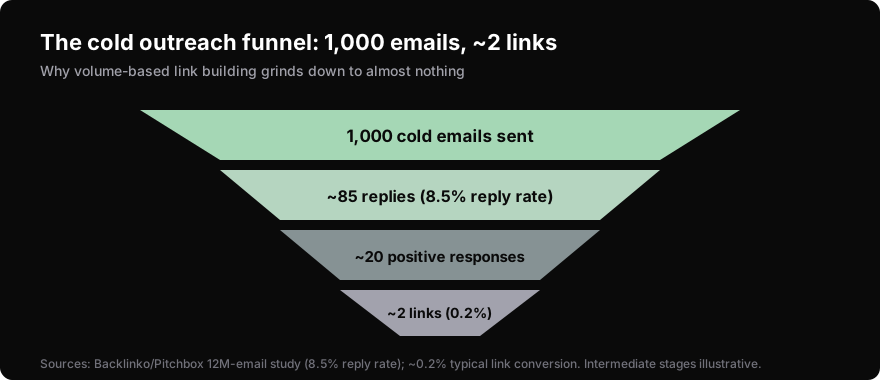
Cold email also scales badly. Inboxes get more crowded every year, spam filters get more aggressive, and recipients spot template patterns instantly. The math doesn't hold at any volume a solo founder can sustain. For the deliverability side of that fight, see our note on cold email deliverability.
What is relationship-based link building?
Relationship-based link building means creating genuine value for people who have audiences, before you ever ask for anything. The links arrive as a byproduct of being useful, visible, and known. This isn't soft theory: with 43.7% of top-ranking pages carrying reciprocal links (Ahrefs, 2026), mutual relationships are already how the top of the SERP gets built.
In practice it looks like this:
- You comment on a blogger's post with something substantive that adds to the conversation
- They notice your name over the next few weeks across their community
- You share their content with actual commentary, not a bare retweet
- Eventually you reach out with a relevant pitch, and they already know who you are
Editorial links from known, trusted voices carry more algorithmic weight than links scraped from outreach campaigns. Building that reputation takes time, but it compounds. Here's a realistic timeline.
| Phase | Timeline | Activities | Expected Links |
|---|---|---|---|
| Build Target List | Week 1 | Identify 30-50 people, set up RSS tracking | 0 |
| Give Value | Months 1-2 | Comment, share, engage 3x/week (zero asks) | 0 |
| First Outreach | Month 3 | Warm outreach to most engaged contacts | 3-5 |
| Momentum | Months 4-6 | Mix of earned and requested mentions | 10-20 |
| Compounding | Month 6+ | Reputation drives unprompted mentions | 20+ per quarter |
Why bother? Because backlinks still decide rankings. The #1 Google result has 3.8x more backlinks than positions #2 through #10, and about 3x more referring domains (Backlinko, updated 2025). Domain diversity beats raw link count, which is exactly what a relationship portfolio produces.
What's the four-part system that makes it scalable?
The knock on relationship building is that it doesn't scale. That's only true without a system. SEO professionals already spend 1 to 2 hours building a single link the hard way (Aira via Ahrefs, 2026), so a repeatable framework that earns links passively is a direct time win. Here's the four-part version.

1. Build a target list of 50 to 100 people
Forget mass prospecting. Pick 50 to 100 people in your niche whose content you genuinely respect: bloggers, journalists, podcast hosts, community builders. Use Ahrefs or Semrush to find who consistently earns backlinks in your space, and check who your competitors' best links come from. Put them in a simple spreadsheet: name, site, social handles, topics, last interaction date. The same list-building discipline shows up in our first 100 users playbook.
2. Give before you ever ask
For 60 to 90 days, your only job is to show up and add value. No pitches. Leave comments that add a data point or a counterexample. Share their work with a real take. Answer questions in their newsletters or communities. Mention their work in your own content with a proper attribution link. Recognition creates the baseline of trust that makes any future ask land differently.
3. Create content that earns mentions naturally
The best link bait isn't clickbait, it's content people in your niche actually reference. Original research earns the most: run a survey of 100 customers, compile a data set that doesn't exist yet, write the definitive comparison practitioners keep searching for. When you publish it, you have a real reason to reach out: "I thought you might find this useful given what you wrote about X." That's a warm follow-up, not a cold pitch. Our content marketing for founders guide covers how to produce that kind of asset on a tight schedule.
4. Move to direct conversation at the right moment
After weeks of consistent engagement, most people recognize your name, and some will have already linked to you unprompted. For the rest, this is when outreach works. Personalization is the multiplier here: a personalized email body lifts replies by 32.7%, a personalized subject line by 30.5%, and a single follow-up by 65.8% (Backlinko). A message built on a real relationship uses all three naturally.
Which tools make the system manageable?
You don't need expensive software. The whole system runs on maybe 3 to 4 hours a week, which matters when the industry average is 1 to 2 hours per link built cold (Aira via Ahrefs, 2026). Four tools keep it sustainable.

RSS reader (Feedly or Inoreader): Follow your 50 to 100 targets so you see new content without checking every site. Set aside 20 minutes, three times a week, to read and engage.
Notion or Google Sheets: Track interactions. Note when you last commented, shared, or messaged each person, so relationships never go cold by accident.
LinkedIn and X: This is where most content creators are actually active. Engage where they spend time, not just on their blogs, the same principle behind any social media marketing effort.
Hunter.io or Snov.io: For when you're ready to reach out directly and need a verified contact email.
What mistakes kill relationship-based link building?
Most failures trace back to impatience. With reply rates at 8.5% even for good outreach (Backlinko), the entire point of this approach is to skip that cold-start penalty, and rushing throws the advantage away. Five mistakes do the most damage.
Going too wide too fast. Maintaining 300 relationships means doing a bad job with all of them. Start with 30 and do it well before expanding.
Asking too soon. Commenting twice and then pitching is cold outreach with extra steps. Give it at least six to eight weeks of consistent presence first.
Treating it like a campaign. Cold outreach has a start and end date. Relationship building doesn't. The people earning 50 to 100 links a year run it as an ongoing practice, not a quarterly sprint.
Being forgettable. Generic comments and bare retweets don't build recognition. Your engagement has to be specific enough that someone reading it knows you actually consumed the content.
Neglecting your own content. If someone checks your site after seeing your comment and finds thin or stale content, the relationship stalls. Your content is part of the trust signal, the same way it is in any organic user growth channel.
What results can you realistically expect?
Don't expect 50 links in month one. Expect a curve: months 1 to 2 are pure relationship building with zero asks, month 3 brings first outreach and 3 to 5 links, months 4 to 6 build momentum toward 10 to 20, and month 6 onward compounds as people mention you unprompted. Given that 95% of pages have zero backlinks (Backlinko), even a modest, diverse link portfolio puts you ahead of most of the web.
Backlink acquisition is consistently named one of the top three SEO challenges for businesses, mostly because people keep brute-forcing it with volume. The teams that win play the longer game. The 0.2% cold-email rate isn't a failure of effort, it's a failure of approach. Relationships produce links that are harder to earn, harder to replicate, and far more durable in rankings.
Start with 30 people this week. Show up for them. The links follow. Pair this with our cold email guide for the moments when direct outreach is the right move, and the SaaS marketing hacks playbook for everything around it. Reddit and community channels work the same way, as our Reddit marketing guide shows.
Frequently Asked Questions
How is relationship-based link building different from cold outreach?
Cold outreach asks strangers for a favor and gets a reply just 8.5% of the time (Backlinko/Pitchbox, 12M emails), converting to links at roughly 0.2%. Relationship building creates value over 60-90 days before any ask, so your outreach lands with people who already recognize your name and converts far higher.
How many relationship targets should I start with?
Start with 30 people whose content you genuinely respect, then expand to 50-100 once those are warm. Going too wide too fast means doing a bad job with everyone. With 73.6% of domains carrying reciprocal links (Ahrefs, 2026), depth of relationship beats breadth of list.
How long before I see links from this approach?
Months 1-2 are pure relationship building with zero asks. Month 3 brings first outreach and 3-5 links. By months 4-6, expect 10-20 from earned and requested mentions. Compounding returns, where people link to you unprompted, start around month 6 and grow each quarter.
Do backlinks still matter for rankings in 2026?
Yes. The #1 Google result has 3.8x more backlinks than positions #2-10 and about 3x more referring domains (Backlinko, updated 2025). Top pages also keep gaining 5% to 14.5% new referring domains per month (Ahrefs, 2026). Domain diversity, which relationships produce, matters more than raw count.
What tools do I need for relationship-based link building?
An RSS reader (Feedly or Inoreader) to follow targets, Notion or Google Sheets to track interactions, LinkedIn and X for engagement, and Hunter.io or Snov.io for verified emails when you reach out. The system runs in 3-4 hours a week, versus the 1-2 hours per single link cold outreach typically costs (Aira via Ahrefs, 2026).
Sources
- Backlinko + Pitchbox, We Analyzed 12 Million Outreach Emails, 2019. 8.5% reply rate; personalized body +32.7%, follow-up +65.8%, multiple contacts +93%.
- Backlinko, We Analyzed 11.8 Million Google Search Results (updated April 2025). #1 result has 3.8x more backlinks; ~95% of pages have zero backlinks.
- Ahrefs, 107 SEO Statistics for 2026. 73.6% of domains have reciprocal links; 43.7% of top-ranking pages do; +5-14.5% new referring domains/month.
- Aira, The State of Link Building (via Ahrefs, 2026). SEO professionals spend 1-2 hours to build a single link.
- Ahrefs. 66.31% of pages have zero referring domains.