Most founders who say they hate marketing actually hate performing. The hollow LinkedIn posts, the forced engagement threads, the feeling of shouting into a void. That's reasonable. And here's the good news: your buyers feel the same way. 67% of B2B buyers now prefer a rep-free buying experience, and 70% prefer a completely digital, self-service one (Gartner, 2026). Nobody wants to be sold to. So stop selling, and start being findable and useful.
This guide is for the technical or product-focused founder who wants real users without building a personal brand or running ads.
Key Takeaways
- You don't have to hard-sell: 67% of B2B buyers prefer a rep-free experience and 70% want fully self-service buying (Gartner, 2026).
- Organic compounds where paid rents: SEO converts at 2.4% vs 1.3% for PPC (First Page Sage, 2025).
- You need one ranking page, not fifty. The average top-ranking page is 1,447 words (Backlinko). Cover the topic completely.
- Recommendations from people you know are the most-trusted channel at ~88% (Nielsen). Your early users are your distribution.
- Answer 10 questions for every 1 product mention. A realistic 90 days gets you 20-50 active users and one ranking page.
Why should you start with the problem, not your product?
The biggest organic-growth mistake founders make is talking about their product before anyone cares. B2B buyers spend just ~17% of their total buying time meeting with potential suppliers (Gartner), and almost none of it wants a pitch. Before you post, write, or build a community, own a problem in one specific place.

Pick one platform where your target users already complain about the problem you solve:
- A subreddit (r/projectmanagement, r/solodev, r/freelance)
- A Slack or Discord community
- X hashtags or search results
- Indie Hackers or Hacker News
- A specific Facebook group
Spend two weeks reading, not posting. Note the exact language people use, the phrases in their complaints and rants become your copy later. This costs zero dollars and usually surfaces more insight than a paid research session. Our Reddit marketing guide goes deep on finding the right community.
How do you build credibility before pitching?
Answer real questions before you pitch anything. According to Ahrefs, 96.55% of pages get zero organic traffic from Google, usually because the content wasn't written for a question anyone was actually asking. The same logic governs communities: founders who post about their product immediately get ignored or banned. Founders who answer 15 real questions first get DMs asking for access.
Here's how to do it without it eating your week:
- Set up a Google Alert or a free tool like F5Bot to monitor keywords related to your problem.
- When someone asks a question you can genuinely answer, write a thorough response. No links, no product mentions.
- After 3-4 solid answers in a community, a single mention of your tool lands differently.
The ratio that works: answer 10 questions for every 1 mention of your product. It feels slow. It works.
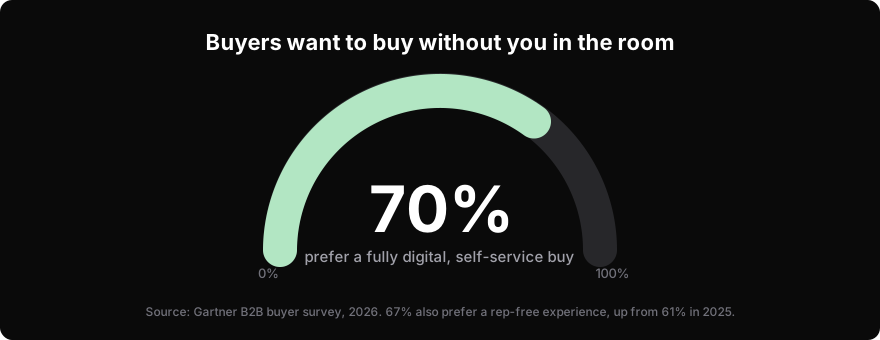
This is why the soft approach outperforms the hard sell. With 70% of buyers preferring to buy with no rep involved, the founder who shows up as a helpful expert is exactly who they want to find, not someone chasing them with a pitch.
What content do you actually need to rank?
You don't need a content calendar or 50 blog posts. You need one piece of content that ranks for a term your users actually search. It's worth the effort because organic converts: SEO leads close at 2.4% versus 1.3% for PPC, nearly double (First Page Sage, 2025). Paid traffic stops the day you stop paying; a ranking page compounds.

Here's how to find the term:
- Type the problem your product solves into Google. Read the autocomplete suggestions and the "People also ask" box.
- Paste those phrases into a free tool like Ubersuggest or Google Keyword Planner. Filter for terms with some monthly volume (100-500 searches is fine at this stage) and low competition.
- Write a post that answers that question better than the top 3 results, deeper, more specific, with examples the others skipped.
The average top-ranking page is 1,447 words (Backlinko), but don't chase a word count, cover the topic completely. One well-placed article can drip leads for years. For a low-effort production system, see our content marketing for founders guide.
How do you turn building into content without performing?
"Building in public" is an overused phrase, but the mechanic is sound: share something real about what you're working on and you give people a reason to follow along. You don't have to share everything or pretend to enjoy it. Websites, blogs, and SEO remain the most impactful marketing channel for B2B (HubSpot State of Marketing, 2026), and build-process content feeds all of them.
The minimum viable version:
- Post one specific thing you shipped or fixed this week.
- Share a screenshot of a bug that frustrated you, or a customer message that changed your direction.
- Write a short post-mortem after a failed experiment.
"Show HN" posts and Indie Hackers milestones work the same way. People root for builders who are specific; vague "exciting progress" updates get ignored. And here's your edge: 50% of small businesses have zero marketing employees (LocaliQ, 2026), so most competitors aren't doing this at all. Showing up consistently gives you visibility that scales without a team, the same compounding logic behind any SaaS marketing hacks you'll read about.
How do you get your first users from direct outreach?
Organic doesn't mean passive. The fastest path to early users is finding the exact person with the problem and sending a short, direct message. This is not cold spam, and the response gap proves it: targeted, reference-specific messages hit 20-40% reply rates versus 2-5% for cold blasts.
The structure that works:
- Find someone who publicly complained about the problem you solve (a tweet, a Reddit post, a forum thread).
- Send a message referencing what they said specifically.
- Offer free access in exchange for honest feedback.
Example: "Saw your post in r/freelance about invoicing tools being a nightmare for international clients. I built something that handles multi-currency invoicing automatically, would you try it free and tell me if it actually solves the problem?"
You're not interrupting with a pitch, you're responding to something they already said. Target 5 people a day for 3 weeks, that's 105 conversations and realistically 20-40 active testers. For more channels, see our first 100 users playbook and the 30 places to get your first 100 users list. When direct messages graduate to email, our cold email guide keeps the same reference-first principle.
How do you turn early users into a growth channel?
Your first 50 users are your best marketing asset, because recommendations from people you know are the single most-trusted channel at roughly 88% (Nielsen), far above any paid format. A warm referral converts better than anything you can buy.

After someone has used your product for 2-3 weeks:
- Ask what they'd say to a friend who had the same problem. Use that language on your homepage.
- Ask if they know anyone else with the same problem. A warm intro beats any cold channel.
- Ask if you can share their results (anonymized or attributed, their choice) as a short case study.
None of this needs a formal referral program. It's just asking people who got value to help you reach others. This is also why product-led growth keeps spreading: 58% of B2B SaaS companies now run a product-led motion and 91% of them plan to invest more (ProductLed, 2025). Let the product do the selling. Product Hunt launches, AppSumo listings, and directory submissions (G2, Capterra) fall in this bucket too, one-time efforts with long-tail visibility.
Which organic-growth traps waste founder time?
A few things look like organic growth but mostly drain time. Avoid them and the 90-day plan below stays realistic.
Posting on every platform at once. Pick one. Master distribution there before expanding. Spreading thin produces nothing, the same focus discipline behind a good social media marketing plan.
Writing generic "tips" content. "5 ways to be more productive" won't rank, won't get shared, won't build trust. Specific, opinionated, problem-focused content does.
Optimizing before you have signal. Under 100 users? Skip keyword density, meta descriptions, and A/B tests. Get real humans using the product first.
Waiting for the product to be "ready." Organic channels compound, so every week you wait is compounding you forgo. You can always sharpen the messaging later.
| Phase | Timeline | Actions | Expected Outcome |
|---|---|---|---|
| Research | Weeks 1-2 | Find your platform, read, note user language | Community understanding |
| Credibility | Weeks 3-5 | Answer questions, no product mentions, set up alerts | Recognition in community |
| Content + Outreach | Weeks 6-8 | Write one ranking piece, start direct outreach (5/day) | 20-40 active testers |
| Referral | Weeks 9-12 | Follow up, ask for referrals and language | 20-50 active users total |
What does a realistic 90-day plan look like?
Weeks 1-2: Identify the one platform where your users live. Read. Note their language.
Weeks 3-5: Answer questions in that community. No product mentions yet. Set up Google Alerts for your problem keywords.
Weeks 6-8: Write one piece targeting a specific search term. Post it. Start direct outreach to people who've publicly described your problem.
Weeks 9-12: Follow up with early users. Ask for referrals and language. Make one community post that mentions your product naturally while helping someone.
At 90 days you should have 20-50 active users, one ranking page (maybe still climbing), a few referrals in the pipeline, and a clear read on which channel works. There's no viral moment and no growth hack here. But it compounds. Six months of this builds something no ad budget can buy: a real reputation in a real community of buyers. When you're ready to add outreach-driven backlinks, our relationship-based link building guide picks up where this leaves off.
Frequently Asked Questions
Do I need to build a personal brand to grow organically?
No. You need to own a specific problem in one specific place. With 67% of B2B buyers preferring a rep-free experience (Gartner, 2026), showing up as a helpful expert beats performing. Read where your users complain, answer genuinely, and your expertise does the marketing.
How many pieces of content do I actually need?
One. You need a single piece that ranks for a term your users search. The average top-ranking page is 1,447 words (Backlinko), but cover the topic completely rather than chasing a count. Organic is worth it: SEO converts at 2.4% vs 1.3% for paid (First Page Sage, 2025).
What is the fastest way to get my first 20 users?
Direct outreach to people who publicly complained about the problem you solve. Send 5 messages a day for 3 weeks. Reference their specific post and reply rates hit 20-40%, versus 2-5% for generic cold blasts. Offer free access for honest feedback.
How do I turn early users into a growth channel?
After 2-3 weeks of use, ask what they'd tell a friend with the same problem (use that language in your copy), whether they know anyone else with it, and if you can share their results. Recommendations from people you know are the most-trusted channel at ~88% (Nielsen).
What does a realistic 90-day growth plan look like?
Weeks 1-2: research your platform. Weeks 3-5: answer questions, no product mentions. Weeks 6-8: write one ranking piece and start direct outreach. Weeks 9-12: follow up for referrals. Target 20-50 active users by day 90, plus one ranking page that keeps compounding.
Sources
- Gartner, 2026. 67% of B2B buyers prefer a rep-free experience; 70% prefer fully digital self-service.
- Gartner, 2025. 61% of B2B buyers preferred a rep-free buying experience (prior-year trend).
- First Page Sage, 2025. SEO converts at 2.4% vs 1.3% for PPC.
- ProductLed, 2025. 58% of B2B SaaS run a product-led motion; 91% plan to invest more.
- HubSpot, State of Marketing 2026. Websites, blogs, and SEO remain the most impactful B2B channel.
- Backlinko. Average top-ranking page is 1,447 words (11.8M results analyzed).
- Ahrefs. 96.55% of pages get zero organic traffic from Google.
- Nielsen, Global Trust in Advertising. ~88% trust recommendations from people they know, the most-trusted channel.
- LocaliQ, 2026 Small Business Marketing Report. 50% of small businesses have zero marketing employees.