Originally shared by Felix Lee on Twitter.
By Felix Lee
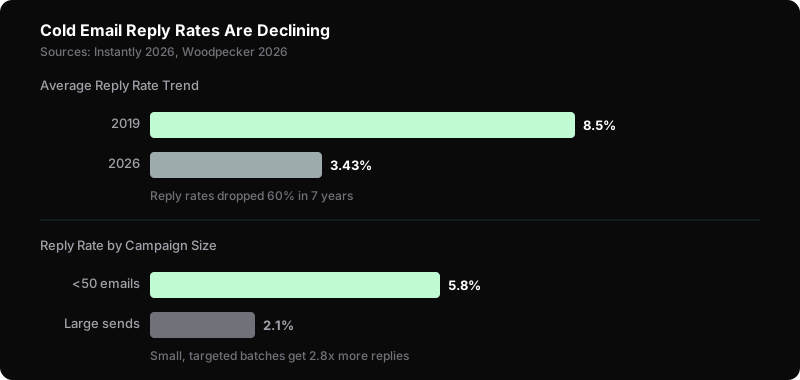
The average cold email reply rate has dropped to 3.43% in 2026, down from 8.5% in 2019, according to Instantly's benchmark report analyzing billions of email interactions. Most cold emails get deleted in under two seconds. The ones that get replies share one trait: the recipient feels like you wrote it only for them.
This guide covers the mechanics, templates, and follow-up sequences that still work, tested across 500 real sends. No theory. Just what produced replies and what didn't.

Key Takeaways
- Average cold email reply rate: 3.43% in 2026, down from 8.5% in 2019 (Instantly, 2026)
- Highly personalized emails increase reply rates by up to 142% (Woodpecker, 2026)
- Campaigns under 50 recipients average 5.8% reply rate vs 2.1% for large sends
- The follow-up, not the first email, is where most replies actually come from
Why Do Most Cold Emails Get Deleted?
Cold email reply rates have plummeted to 3.43% in 2026, down from 8.5% in 2019, according to Instantly's benchmark report analyzing billions of email interactions. The core problem isn't deliverability or timing. It's that most outreach reads like a mass template, and recipients can tell within two seconds.
The person you're writing to gets dozens of cold pitches daily. They decide in roughly two seconds whether to open, and another two seconds whether to reply.
Most outreach fails for the same reason: it's about the sender. Their title, their company, their product. It reads like a template pasted into a list of 500 names, because it was.
Woodpecker's analysis of 20 million+ cold emails found that customized subject lines improve open rates by up to 50%, and highly personalized emails can boost reply rates by up to 142% (Woodpecker, 2026). That gap between generic and personalized isn't incremental. It's the difference between getting ignored and starting a conversation.
A polished template is still a template. Your goal isn't "well written." Your goal is "a real human clearly typed this for me."
If you're using cold email as part of your early user acquisition strategy, this distinction matters even more. Your first users need to feel chosen, not targeted.
How Should You Structure a Cold Email?
Keep it under 90 words. Instantly's data shows that campaigns under 50 recipients average a 5.8% reply rate vs 2.1% for large sends. Smaller batches force better personalization, and better personalization drives replies.
The anatomy of a cold email that works:
- Subject line: Short, lowercase, about them. "quick one about [their thing]" beats "[Company Name] Partnership Opportunity" every time.
- Line 1: About them, never about you. This is your notification preview. Often it's the only thing they see before deciding to open.
- Body: The problem you think they have, in plain language. One to two sentences max.
- Ask: One clear request. A 15-minute call or a free trial. Not both. Emails with a single call to action generate significantly more replies than those with multiple asks.
Quick test: if your first line starts with "we," "I," or your company name, rewrite it. If the email runs past 90 words, cut it.
For email deliverability tips on avoiding spam filters, we cover the technical side separately. This guide is about what to write once your emails actually land in the inbox.
What Works on LinkedIn Outreach?
LinkedIn is a different animal than email. Connection requests average a 28.5% acceptance rate across the platform, with personalized requests pushing that to 45%, according to Expandi's 2026 benchmark study.
Here's what most people get wrong: they attach a long note to the connection request. Don't. Send the connection request with no note. Empty requests get accepted more often because a note triggers a second notification the moment they accept, which is one more thing to clear. Many people decline rather than deal with it.
Once they accept, wait a few days before messaging. Hitting them the second you connect feels automated, and people can sense it.
No reply after two weeks? Send an InMail with no subject line. LinkedIn bolds the subject field, and people now read bold lines as ads on sight. A blank subject looks like a normal person sending a normal message.
If your product serves a specific professional type, LinkedIn search filters (job title + company size + location) let you build a highly targeted list. Our growth playbook shows how one founder ran 8 LinkedIn accounts sending 280 connection requests daily.
What Works for X (Twitter) DMs?
No subject line, lowercase, two to four lines max. X DMs work best when there's existing context: they followed back, replied to a post, or liked something you wrote.
Use that context. "Saw your reply about [topic], building something around exactly that. Want an early look?" converts because it references a real interaction, not a scraped lead list.
We've covered the full X marketing system for solo founders. The short version: DM your ideal users instead of posting into the void and hoping they find you.
Which Tactics Actually Increase Reply Rates?
Highly personalized cold emails boost reply rates by up to 142% compared to generic templates, according to Woodpecker's analysis of 20 million+ cold emails. Customized subject lines alone improve open rates by 50%. The gap between generic and personalized outreach isn't incremental, it's the difference between silence and a conversation.

You don't cram all of these into one message. Pick two or three that fit the situation.
Make them feel chosen. Specificity does the heavy lifting. "I made a short list of people I wanted in early, you're on it." The vaguer it gets, the more it reads like a blast.
Open with a hook about them. Your first line is your most valuable real estate. Spend it on their work, their world, or a mutual connection. Never open with "I noticed that." It telegraphs a pitch and they brace for it.
Name the objection before they can. Saying the reason they'd ignore you disarms it. "You don't know me, so feel free to ignore this, but I think it's actually for you." That makes you sound like a person instead of a sequence.
Make the ask weightless. The yes should cost nothing. Don't ask for 30 minutes, ask for a glance. "Want the 90-second version? I'll drop it right here."
Prove demand without bragging. Small, specific proof beats any adjective. "Showed this to five people Monday, four asked in." The moment it becomes "everyone loves it," they stop believing you.
Make it unmistakably about them. Don't just name a detail, connect it to why you're writing. "You wrote about this problem last week, this is the fix for exactly that." Generic "love what you're building" does none of this and should be deleted.
Use a lowercase first name. Type "hey tom," not "hey Tom." Automations auto-capitalize names, so lowercase is a quiet signal that a human typed this by hand.
Keep it short. Under 50 words for a DM. Length is just more reasons to leave.
One ask per message. Two asks double the work to reply, so people do neither.
How Do You Sound Human Instead of AI-Generated?
A message can hit every tactic above and still feel robotic, because it's too smooth. Polish is the tell.
Things that quietly signal "AI wrote this":
- Tidy wordplay and balanced phrases ("content, not a contract")
- Lists of exactly three things, everywhere
- Neat summary lines that wrap up with a bow
- Every sentence the same length and shape
- Generic enthusiasm: "amazing opportunity," "genuinely excited"
What real writing looks like:
- Lowercase, contractions, the occasional fragment
- Lumpy rhythm. A short line, then a longer one, then three words.
- One concrete detail instead of a smooth abstraction
- A small aside no template would bother with ("bit of a long shot")
When a draft reads clean and balanced, rough it up. Cut a connective, break the symmetry, let one line run short. Smooth is forgettable.
Templates You Can Steal
Adapt every line to the real person and the real offer. These are starting points, not copy-paste jobs.
When you have no proof yet:
hey [name] :)

bit of a long shot. i'm building [one line on what it does], and you're one of maybe five people whose honest take i'd actually trust.

can i show you what i've got?
When a mutual connection sent you:
hey [name], [mutual] said you're the person who actually gets [topic]. i'm working on [one line] and would love your eyes on it for two minutes. open to it?When they engaged with your content:
hey [name], saw your comment on my post about [topic]. [one real reaction to it]. building something around exactly that. want an early look?When they gave you a soft no:
totally fair, [name], i won't chase you. want me to send over [the one genuinely useful thing] so it's there when the timing's better?These templates work for link building outreach too, not just sales. The principles are identical: specificity, low-effort ask, human tone.
How Should You Follow Up?
Most replies come from follow-ups, not initial emails. Woodpecker's data shows that sequences with three to four follow-ups generate significantly more total replies than single-touch outreach. The optimal cadence spaces messages 3-7 days apart, with each touch adding new value rather than simply "bumping" the thread.

Most first messages get no reply. That's normal. The follow-up is where conversations actually start.
Skip "just bumping this up." The move that works is handing them an easy no, so they stop bracing and actually answer:
hey [name],

just checking in, any thoughts on [the thing]?

wanted to give you first dibs.

no worries if it's not the right fit right now.
That last line looks too soft to do anything. It's the line that revives conversations you'd written off. Never beg, and always leave an exit.
Follow-up timing:
| Touch | Timing | Purpose |
|---|---|---|
| Email 1 | Day 0 | Initial outreach |
| Follow-up 1 | Day 3 | Quick check-in, add one new detail |
| Follow-up 2 | Day 7 | Easy-no template above |
| Follow-up 3 | Day 14 | Share something genuinely useful (no ask) |
| Final | Day 21 | Breakup email: "closing the loop, no worries" |
Three to four follow-ups is the sweet spot. After that, you're hurting your sender reputation more than you're gaining replies.
What Tools Do You Need?
You don't need expensive tools at this stage. Here's what works:
- Finding emails: Hunter.io (25 free searches/month), Apollo.io (free tier), or use Google scraping techniques to find contact info.
- Sending: Your regular Gmail or Outlook for the first 50 sends. Instantly or Lemlist when you need sequences.
- Tracking: A spreadsheet with columns for name, email, date sent, response, and next action. Graduate to a CRM when volume justifies it.
- AI assist: AI outbound tools can help with research and personalization at scale, but use them for research, not for writing the actual email.
For a broader view of which growth channels work at each revenue stage, we rank them from $0 to $100K MRR.
What Should You Track?
The 2026 average cold email reply rate sits at 3.43%, according to Instantly's benchmark report. Elite performers hit 10.7%+. Tracking four metrics, open rate, reply rate, positive reply rate, and meetings booked per 100 sends, tells you exactly where your outreach breaks down and what to fix first.
Four metrics tell you everything:
- Open rate (target: 40-60%). Below 40% means your subject lines need work or you have deliverability problems.
- Reply rate (target: 5-10%). The 2026 average is 3.43%. If you're above 5%, your personalization is working.
- Positive reply rate (target: 2-5%). Not all replies are good. Track how many lead to actual conversations.
- Meetings booked per 100 sends. This is the number that matters for your business. Most founders find 2-5 meetings per 100 well-targeted sends.
Update these weekly. You'll quickly see which templates, subject lines, and audience segments perform. Double down on what works. One founder went from $0 to $700 MRR by tracking exactly which outreach messages converted.
Before You Hit Send
Show the draft to someone who actually receives messages like this all day. If you don't have that person, find one. ADPList.org connects you with experienced mentors for free. A real human reading your actual draft is worth more than any template.
Write the draft. Then go find the person who can tell you what's off.
Framework adapted from Tom Orbach's Marketing Ideas newsletter.
Once your cold outreach brings in subscribers, you'll need a system to keep them engaged. Our email marketing guide covers the automated sequences that turn cold leads into paying customers.
Frequently Asked Questions
How many cold emails should you send per day?
Start with 10-20 per day from a warmed-up email account. Sending too many too fast triggers spam filters and tanks your domain reputation. Instantly's 2026 data confirms that campaigns under 50 total recipients outperform large sends by nearly 3x on reply rate. Quality over quantity, especially in the first month.
What's a good cold email reply rate in 2026?
The average across all industries is 3.43%, according to Instantly's 2026 benchmark report. Elite performers hit 10.7%+. If you're consistently above 5%, your targeting and personalization are working. Below 2%, something is fundamentally wrong with your list, your message, or your deliverability.
Should you use AI to write cold emails?
Use AI for research (company background, recent news, mutual connections) but write the actual email yourself. AI-generated emails have tells that recipients increasingly recognize: balanced phrasing, tidy three-item lists, em dashes everywhere. The whole point of cold email is sounding human. Let AI do the prep work, then write 50 words yourself.
How long should a cold email be?
Under 90 words for the body. Under 50 words for a DM. The instinct to explain more is almost always wrong. Shorter emails consistently outperform longer ones because busy people scan, they don't read. If you can't explain why you're reaching out in three sentences, you don't understand your own value prop well enough.
Is cold email still legal in 2026?
In the US, CAN-SPAM requires a physical address, an unsubscribe mechanism, and honest subject lines. In the EU, GDPR requires legitimate interest or consent. In Canada, CASL is stricter and generally requires prior consent. B2B cold email is legal in most jurisdictions when you follow the rules, but always check local regulations. The bigger risk isn't legal trouble; it's getting your domain blacklisted by sending too much too fast.
Sources
- Instantly. "Cold Email Benchmark Report 2026." Billions of email interactions analyzed, 2026.
- Woodpecker. "Cold Email Statistics." Analysis of 20M+ cold emails, 2026.
- Expandi. "LinkedIn Outreach Benchmarks 2026." 13.2M data points, 2026.
- Woodpecker. "Cold Email Reply Rate." Industry-specific reply rate benchmarks, 2026.
- Tom Orbach. "Marketing Ideas Newsletter." Cold outreach framework and templates.
- Hunter.io. "Email Finder." Free-tier email lookup tool.
- ADPList. "Find a Mentor." Free mentorship platform for outreach feedback.