By Pablo Bravo
Generative Engine Optimization (GEO) is the practice of formatting your content so AI assistants quote it in their answers. It's also called Answer Engine Optimization (AEO). The goal isn't a blue link anymore — it's being the source ChatGPT or Perplexity names when someone asks a question in your niche.
This matters because search is moving. ChatGPT crossed 800 million weekly active users in October 2025. And when Google shows an AI summary, users click a traditional link just 8% of the time versus 15% without one, per Pew Research. Fewer clicks are up for grabs. Getting cited is how you stay visible.
The good news: the tactics are concrete, and most founders aren't doing them yet. This guide walks through every signal that gets you quoted.
Key Takeaways
- Adding statistics, quotations, and cited sources lifts AI visibility up to 25-28%, per the Princeton GEO study
- Brand mentions correlate roughly 3x more strongly with AI citations than backlinks do (Semrush, 2026)
- Answer-first passages, question H2s, and clean structured data make you easy to lift and quote
- You can allow AI search crawlers (OAI-SearchBot, PerplexityBot) while opting out of training crawlers — they're separate
What Is GEO and Why Does It Matter Now?
GEO is optimizing content for AI answer engines instead of the ten blue links. Traditional SEO gets you ranked. GEO gets you quoted inside the answer someone actually reads.
The shift is measurable. Google AI Overviews appeared on roughly 18% of searches in early 2025 and peaked near 25% of queries by July, according to Semrush data reported by Search Engine Land. Coverage has fluctuated since, but the direction is set: more answers, fewer clicks.

For a bootstrapped founder, that's both a threat and an opening. The threat: your best-ranking page might get summarized without a click. The opening: AI engines cite far more than the top ten results, so a smaller site can win a citation it could never win as a #1 ranking.
GEO isn't separate from good content marketing — it's a sharper version of it. If you already write clear, sourced, useful pages, you're most of the way there. Our lazy content marketing guide covers how to produce that content without burning out.
How Do ChatGPT and Perplexity Choose Sources?
AI assistants pick sources in two steps: retrieval, then citation. First they search a live index (ChatGPT uses Bing plus its own crawl; Perplexity runs its own index) and pull candidate pages. Then the model reads those pages and decides which passages to quote.
Two things drive whether you make the cut.
Retrievability. Your page has to be crawlable, indexed, and topically clear. If the AI crawler can't fetch it, or your answer is buried under 400 words of preamble, you won't be retrieved.
Reputation. AI engines lean on brand signals. Sites mentioned often across the web get cited more. Semrush found that pages with over 32,000 referring domains are 3.5x more likely to be cited by ChatGPT than pages with fewer than 200 (Semrush AI Visibility Index, 2026).
Here's the surprising part. Ranking #1 on Google is no longer required. Ahrefs found only 38% of AI Overview–cited pages also rank in Google's top 10, down sharply from 76% a few months earlier, per Search Engine Journal. Ranking helps. It isn't the gate.
What Content Gets Cited by AI?
The Princeton "Generative Engine Optimization" study tested nine content tactics across thousands of queries. Three won decisively: adding quotations (27.8% visibility lift), adding statistics (25.9%), and citing sources (24.9%). Old-school keyword stuffing came last at 17.8% (arXiv).
The lesson is blunt. AI engines quote content that looks quotable: specific numbers, named sources, and clean, self-contained statements.
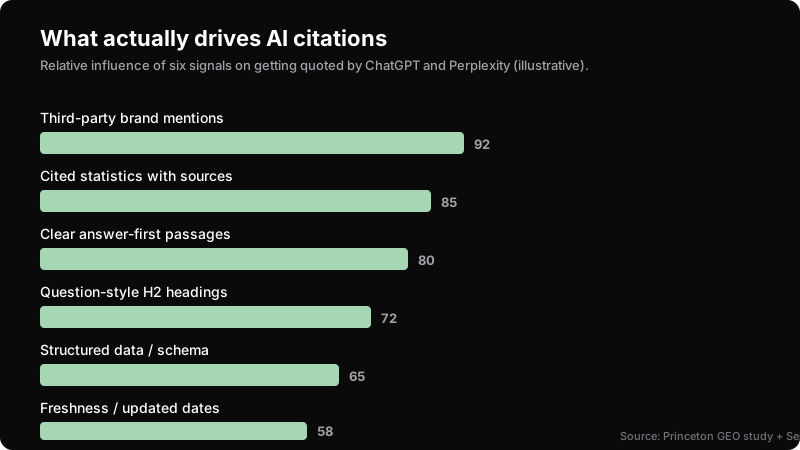
Here are the on-page signals that make a passage easy to lift, and exactly how to build each one.
| Citation signal | Why it matters | How to implement |
|---|---|---|
| Answer-first passages | The model can lift a clean, complete answer without stitching sentences together | Open each section with a 2-3 sentence direct answer, then expand below |
| Cited statistics | Named numbers with a source are the single most-quoted content type | Add a real stat with an inline link every few hundred words — never fabricate |
| Question H2 headings | Headings that match how people ask map directly to AI prompts | Phrase H2s as the exact question ("How do I...?") a user would type |
| Structured data / schema | Article, FAQPage, and HowTo schema tell engines what your page is | Auto-generate JSON-LD; expose FAQs and steps as machine-readable markup |
| Lists and tables | Scannable structure is easy for a model to parse and reproduce | Use bullets, numbered steps, and comparison tables for any multi-item answer |
| Freshness / dates | Engines favor current sources for time-sensitive topics | Show a visible "updated" date and refresh stats on a schedule |
Two more on-page moves matter. Entity clarity — name your business, products, and key people consistently so the model connects the dots. And a dedicated FAQ section with real questions, which doubles as citation bait and structured data. Our blog post ideas guide shows how FAQ-style posts earn both AI citations and featured snippets.
Write the way you'd answer a customer: state the answer, back it with a number, name your source. That's the whole formula.
The Off-Site Signals That Get You Mentioned
On-page work makes you quotable. Off-site mentions make you trusted. And trust is where most citations are actually won.
The data is striking. Brand mentions correlate roughly 3x more strongly with AI visibility than backlinks, per Semrush's 126-million-prompt index. Meanwhile 62% of AI citations are "ghost citations" — the source is linked but the brand isn't named in the text (Semrush Ghost Citations Study). The takeaway: you want your name showing up everywhere the AI reads, not just a link.
Focus your off-site effort where AI engines actually pull from.
- Reddit and forums. ChatGPT leans heavily on Reddit and Wikipedia, citing around 15 sources per response. Show up in relevant threads with real answers, not spam. Our Reddit marketing tactics guide covers how to do this without getting banned.
- YouTube. YouTube is the single most-cited source in Google AI Overviews. A simple explainer video on your core topic is a citation asset.
- Review sites and directories. Third-party listings with consistent details feed the model's picture of who you are.
- Wikipedia-adjacent references. Getting mentioned in resources that Wikipedia and news sites cite builds the entity trust engines reward.
Keep your NAP — name, address, phone — identical everywhere. Inconsistent business details confuse entity resolution and cost you mentions. This matters doubly for local businesses; our restaurant marketing guide walks through consistent listings.
Earning these mentions is relationship work, not a hack. Our relationship-based link building guide covers the outreach that builds real third-party citations. If you're starting from zero, the promote your startup with zero followers playbook is the right first step.
The Technical Setup: Let the AI Crawlers In
None of this works if the bots can't read you. Three technical moves clear the path.

Allow the right crawlers. AI search runs on different bots than AI training. OpenAI uses OAI-SearchBot to surface you in ChatGPT search, GPTBot for training, and ChatGPT-User for live fetches. Perplexity runs PerplexityBot and Perplexity-User. Anthropic runs ClaudeBot. Per OpenAI's crawler docs, you can allow OAI-SearchBot for visibility while blocking GPTBot from training — they're separate robots.txt directives.
Check your robots.txt today. Many sites accidentally block the exact bots that would cite them.
Add an llms.txt file. Serve a plain-text /llms.txt at your root listing your key pages and what they cover. It's an emerging convention that gives AI crawlers a clean map of your best content. Cheap to add, and future-facing.
Ship clean HTML. AI crawlers parse your rendered page. Content buried in heavy JavaScript, hidden behind interactions, or wrapped in messy markup is harder to extract. Server-render your important text. Use real headings, semantic lists, and a logical structure. The cleaner the HTML, the easier you are to quote.
How Do You Measure AI Citations?
You can't improve what you can't see. AI citations are harder to track than rankings, but not impossible.
Start manual and free. Every week, ask ChatGPT and Perplexity the 10 questions your customers actually ask. Note whether you're cited, mentioned, or absent. Screenshot the wins. This is your baseline, and it costs nothing but 20 minutes.
Watch your server logs and analytics for AI crawler visits — OAI-SearchBot, PerplexityBot, and ClaudeBot hitting your pages means you're in the retrieval pool. Also watch for referral traffic from chat.openai.com and perplexity.ai; both pass clicks when users follow a citation.
For scale, dedicated AI visibility trackers (Semrush's AI toolkit, Profound, and others) monitor citation rates across engines over time. Worth it once you're actively investing in GEO.
Track the trend, not a single snapshot. AI answers vary run to run. What matters is whether your citation rate climbs over a month as you ship the signals above. Pair this with the fundamentals in our email marketing guide and social media marketing guide so citations turn into an audience you own.
Frequently Asked Questions
How long does it take to get cited by ChatGPT or Perplexity?
Perplexity can cite a fresh page within days because it crawls a live index. ChatGPT search is similar for current events but slower for evergreen topics. Expect weeks, not hours, for consistent citations — and faster results on pages that already have brand mentions and backlinks pointing to them.
Do I need to rank on Google to get cited by AI?
No. Only 38% of AI Overview–cited pages rank in Google's top 10, per Ahrefs. Ranking helps you get retrieved, but AI engines cite well beyond the first page. A clear, sourced, well-mentioned page can win a citation it could never win as a top ranking.
What's the difference between GEO, AEO, and SEO?
SEO optimizes for search rankings and clicks. GEO (Generative Engine Optimization) and AEO (Answer Engine Optimization) are near-synonyms for optimizing to be quoted inside AI answers. They overlap heavily with SEO — clean, sourced, structured content wins all three. GEO just adds answer-first formatting and off-site brand mentions as priorities.
Should I block AI crawlers to protect my content?
Only if you don't want the citations. Blocking GPTBot opts you out of training but not necessarily search. If you block OAI-SearchBot or PerplexityBot, you remove yourself from those answer engines entirely. For most businesses seeking visibility, allow the search crawlers and decide separately about training.
Does schema markup actually help with AI citations?
Yes, indirectly. Schema like Article, FAQPage, and HowTo tells engines exactly what your page contains, making the right passages easier to extract. It won't force a citation on weak content, but it removes ambiguity. Combined with answer-first writing and cited stats, structured data makes you meaningfully easier to quote.
Sources
- arXiv (Aggarwal et al., Princeton), "GEO: Generative Engine Optimization," retrieved 2026-07-03, https://arxiv.org/abs/2311.09735
- Pew Research Center, "Google users are less likely to click on links when an AI summary appears in the results," retrieved 2026-07-03, https://www.pewresearch.org/short-reads/2025/07/22/google-users-are-less-likely-to-click-on-links-when-an-ai-summary-appears-in-the-results/
- Semrush, "Semrush Releases Expanded 2026 AI Visibility Index (126M prompts)," retrieved 2026-07-03, https://www.semrush.com/news/463141-semrush-releases-expanded-2026-ai-visibility-index-analyzing-126-million-ai-search-prompts/
- Semrush, "Why 62% of AI citations don't lead to brand mentions (The Ghost Citations Study)," retrieved 2026-07-03, https://www.semrush.com/blog/the-ghost-citations-study/
- Search Engine Land, "Google AI Overviews surged in 2025, then pulled back," retrieved 2026-07-03, https://searchengineland.com/google-ai-overviews-surge-pullback-data-466314
- Search Engine Journal, "Google AI Overview Citations From Top-Ranking Pages Drop Sharply," retrieved 2026-07-03, https://www.searchenginejournal.com/google-ai-overview-citations-from-top-ranking-pages-drop-sharply/568637/
- TechCrunch, "Sam Altman says ChatGPT has hit 800M weekly active users," retrieved 2026-07-03, https://techcrunch.com/2025/10/06/sam-altman-says-chatgpt-has-hit-800m-weekly-active-users/
- OpenAI, "Overview of OpenAI Crawlers," retrieved 2026-07-03, https://developers.openai.com/api/docs/bots
- Perplexity, "Perplexity Crawlers," retrieved 2026-07-03, https://docs.perplexity.ai/docs/resources/perplexity-crawlers