Building an audience from scratch is slow. But distribution doesn't have to wait for an audience. Pinterest reached a record 619 million monthly active users in Q4 2025 (Pinterest Q4 2025 results), and Reddit averaged 121.4 million daily active users (Reddit Q4 2025 results). Both run on search and interest, not on who follows you, which is exactly why they work when your follower count is zero.
Here are seven free tactics worth testing if you're starting from nothing.
Key Takeaways
- Reddit (121.4M daily users) and Pinterest (619M monthly users) distribute by search and interest, not followers (Reddit / Pinterest Q4 2025).
- About 96% of Pinterest searches are unbranded (Sprout Social, 2026), so an unknown startup competes on ideas, not name recognition.
- Reddit is the most-cited domain in Google AI Overviews at ~21% of citations (Semrush, 2025). Your Reddit posts feed AI answers, though the share fluctuates.
- A Pinterest pin keeps driving traffic for months; an X post dies in minutes (Scott Graffius, 2026).
- Start with 2-3 tactics matched to where your audience already is. Run each 4-6 weeks before deciding what to scale.
Why do Reddit and Pinterest work when you have no audience?
Most social platforms reward existing followers. Reddit and Pinterest reward relevance. About 96% of Pinterest searches are unbranded (Sprout Social, 2026), meaning people search for ideas and products, not company names, so a brand-new startup starts on near-equal footing. And ~85% of US Pinterest users have bought something from a pin they discovered.
Reddit works on intent. 77% of Redditors visit two or more communities to validate a purchase (Social Media Today, 2025, reporting Reddit data), so a helpful presence in the right threads reaches people who are actively deciding. The compounding bonus: content here keeps working.
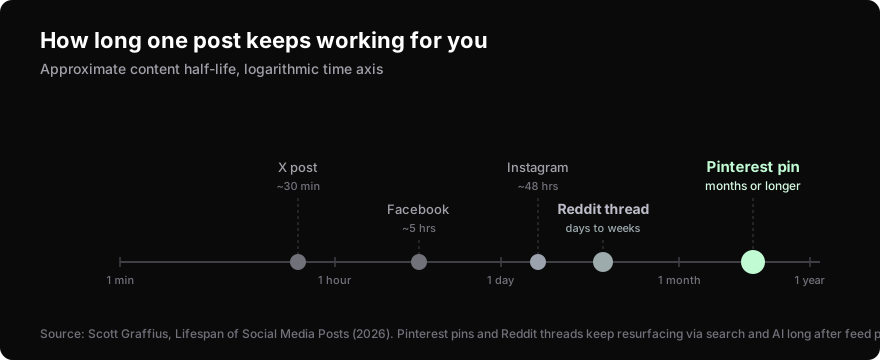
A pin keeps driving traffic for months and a Reddit thread resurfaces for weeks via search, while an X post is effectively dead in minutes (Scott Graffius, 2026). For the deeper Reddit playbook, see our Reddit marketing guide.
How do you mine Reddit threads that already rank on Google?
Reddit threads regularly appear on the first page of Google, so a well-placed comment in the right thread earns both Reddit traffic and Google traffic. That reach now extends to AI answers: Reddit is the most-cited domain in Google AI Overviews at roughly 21% of citations (Semrush, 2025). Half of US shoppers say they fact-check AI product recommendations on Reddit before buying (PPC Land, 2025, Reddit-commissioned).
The workflow:
- Search Google for "[your category] reddit" and note which threads rank on page one for questions your product answers.
- Comment or post from an account with real karma and history. A brand-new account with no track record gets filtered as spam.
- Match your product only to threads where people are genuinely asking the question you answer. If the thread is "what tools do you use for X" and you built an X tool, that's a natural fit.
One caveat worth stating plainly: don't buy upvotes or use vote-manipulation services. Reddit detects and bans for it, and it torches the trust the channel runs on. The whole point is being genuinely useful where it counts.
How do you launch on Hacker News and the right subreddits?
Hacker News runs a weekly "Show HN" thread built specifically for founders sharing what they made. It's free, it draws technical and early-adopter audiences, and a well-received post can drive hundreds of signups overnight. Reddit offers the same launch energy across dozens of builder communities.
These subreddits accept startup and product posts:
- r/RoastMyStartup (honest feedback), r/AlphaandBetausers (beta testers), r/IMadeThis and r/SideProject (launches)
- r/Entrepreneur, r/EntrepreneurRideAlong, r/Startups, r/SmallBusiness, r/GrowthHacking
- Niche-specific: r/SEO, r/SocialMediaMarketing, r/Content_marketing, r/AskMarketing
Don't blast all of them the same day. Spread posts out, tailor the framing to each community, and read the rules first. Getting banned from a 500k-member subreddit is an own goal. For more launch surfaces, see the 30 places to get your first 100 users list and our first 100 users playbook.
How do you use Pinterest group boards to skip audience-building?
Pinterest group boards let you post directly to an audience that already follows the board, no following of your own required. Some boards have tens of thousands of followers, and since ~70% of Pinterest's base is women with Gen Z its fastest-growing segment at 39% of the generation (Sprout Social, 2026), the targeting can be sharp.
How to find them:
- Search your main keyword on Pinterest, then filter results to Boards.
- Look for boards with a "Request to join" button, those are open group boards.
- Send a polite, specific request explaining what you create.
Once accepted, every pin you post reaches the board's followers. Infographics and how-to visuals perform best. One free optimization with outsized payoff: add descriptive alt text to every pin. Pins with alt text earn about 123% more outbound clicks, against a ~1.2% average (WebFX, 2025). It also makes your pins accessible, the same principle behind any good social media marketing effort.
How do you write Reddit listicles that include your startup?
A "best tools for X" post on Reddit reads as editorial, but you control who makes the list. Include your startup as one item among several legitimate competitors and it lands as a recommendation, not an ad. It only works if the list is genuinely useful, Reddit users shred thinly veiled promotion.
Here's how to build one worth reading:
- Use a competitor tool (Semrush, Ahrefs) or a Google search for "[your category] alternatives".
- Pull 8-10 direct competitors.
- Research each honestly: what they do well, what they're missing, who they're best for.
- Write a listicle covering all of them, including your product with its real strengths.
- Post it in relevant subreddits, framed for each community.
If your product belongs on the list, let the comparison make the case. This is the same trust-first logic behind relationship-based link building: earn the mention, don't demand it.
How do you pull warm leads from the Facebook Ads Library?
People who comment on competitor ads have already signaled interest in what you sell. The Facebook Ads Library makes those ads publicly visible, and the comments are often accessible too. That's better targeting than most paid campaigns, because you're reaching people who engaged with a competing offer.

The process:
- Open the Facebook Ads Library and search competitors or products in your niche.
- Find active ads with comments.
- Save the profiles of people who commented.
- Send a short message: "Hey! Saw you're interested in [topic]. You can grab [your freebie] today, it [one-sentence description]. Here: [link]."
This is cold outreach, so expect a low reply rate. Keep it short, lead with a free resource, and don't pitch paid products immediately. When this graduates to email, our cold email guide keeps the reference-first principle intact.
How do you fix internal linking for more organic traffic?
This one costs nothing and most founders skip it. According to Ahrefs, 96.55% of pages get zero organic traffic from Google, and weak internal linking is one of the most common causes. Pages with few internal links don't receive authority from the rest of your site, so they rank lower than they should.
The exact workflow:
- Open Google Search Console and go to the Links section.
- Under Internal links, sort pages by link count, lowest first.
- For each underperforming page, add 10 or more internal links from existing posts pointing to it.
- Add 4-5 outbound links to authoritative external sources on that same page.
This is fixable in an afternoon without writing a single new piece of content. It's the highest-leverage free move on this list for anyone with existing content, and it pairs naturally with the organic user growth approach.
How do you get passive traffic from Giphy?
Giphy GIFs embed natively on Instagram, X, Facebook, iMessage, Slack, and dozens of other apps. When someone searches for a GIF relevant to your industry, yours can show up with your logo or URL baked in. Once set up, the distribution is passive.
How to set it up:
- Create a Giphy account and make 5 original GIFs around topics your audience searches (reactions, tutorials, product demos, industry humor).
- Add your logo or URL as a subtle overlay on each.
- Apply for a free Giphy brand channel, which gives your content priority in search.
- Tag each GIF with relevant keywords so it surfaces.
Every time someone uses your GIF, your branding travels with it. Cumulative reach across platforms compounds over time, especially for GIFs that tap universal reactions or niche inside jokes. It's a small, one-time setup that keeps paying out, much like the tactics in our SaaS marketing hacks playbook.
| Tactic | Cost | Time Investment | Best For |
|---|---|---|---|
| Mine Reddit threads ranking on Google | Free | 1-2 hrs/week | Products solving searchable problems |
| Launch on HN + subreddits | Free | 2-3 hrs one-time per platform | Technical and early-adopter audiences |
| Pinterest group boards | Free | 1 hr/week | Visual, consumer, and education products |
| Reddit listicles with your startup | Free | 2-3 hrs per post | Products with clear competitors |
| Facebook Ads Library leads | Free | 1-2 hrs/week | B2C products with competitor ads |
| Internal linking fixes | Free | 2-4 hrs one-time | Sites with existing content |
| Giphy branded GIFs | Free | 3-4 hrs setup | Consumer brands and personality-driven products |
Which tactics should you start with?
None of these need a budget. They need time and some experimentation. The Reddit and Pinterest plays borrow existing audiences, the internal linking fix compounds as rankings improve, and Giphy plus Ads Library create touchpoints with people already interested in your category.
Start with two or three that match where your audience already spends time. Run each for four to six weeks before deciding what to double down on. Distribution isn't a one-time sprint, it's a system you build piece by piece.
Frequently Asked Questions
Which of these 7 free traffic tactics should I try first?
Start with internal linking fixes (tactic 6) since it costs nothing and works immediately on existing pages. Then try Reddit thread mining and Pinterest group boards depending on your audience. With 96% of Pinterest searches unbranded (Sprout Social, 2026), an unknown startup can rank on ideas alone.
Do Reddit posts really help with Google and AI search?
Yes. Reddit threads frequently rank on Google's first page, and Reddit is the most-cited domain in Google AI Overviews at ~21% of citations (Semrush, 2025). The share fluctuates month to month, so treat it as a strong but variable tailwind, not a guarantee.
Do Pinterest group boards still work for free traffic?
Yes. Search your keyword on Pinterest, filter by Boards, and look for a "Request to join" button. Pinterest has 619M monthly users (Pinterest Q4 2025), and pins with alt text earn ~123% more outbound clicks (WebFX, 2025).
Is outreach through Facebook Ads Library spammy?
It's cold outreach, so expect low reply rates. But the targeting beats most paid campaigns because you reach people who actively engaged with a competing offer. Lead with a free resource, keep it short, and don't pitch a paid product in the first message.
How does internal linking improve organic traffic?
Pages with few internal links miss authority passed from the rest of your site. According to Ahrefs, 96.55% of pages get zero organic traffic, and poor internal linking is a common cause. Add 10 or more internal links to underperforming pages to fix it in an afternoon.
Sources
- Pinterest Inc., Q4 2025 results. Record 619 million monthly active users.
- Reddit Inc., Q4 2025 results. 121.4M daily and 471.6M weekly active users.
- Sprout Social, 2026. ~96% of Pinterest searches are unbranded; ~70% women, Gen Z fastest-growing; ~85% bought from a pin.
- Social Media Today, 2025. 77% of Redditors visit 2+ communities to validate a purchase.
- Semrush, 2025. Reddit is the most-cited domain in Google AI Overviews (~21%).
- PPC Land, 2025 (Reddit-commissioned). Half of US shoppers fact-check AI product picks on Reddit.
- Scott Graffius, 2026. Lifespan of social media posts: Pinterest pins last months, X posts minutes.
- WebFX, 2025. Pinterest pins with alt text earn ~123% more outbound clicks (~1.2% average).
- Ahrefs. 96.55% of pages get zero organic traffic from Google.