By Pablo Bravo
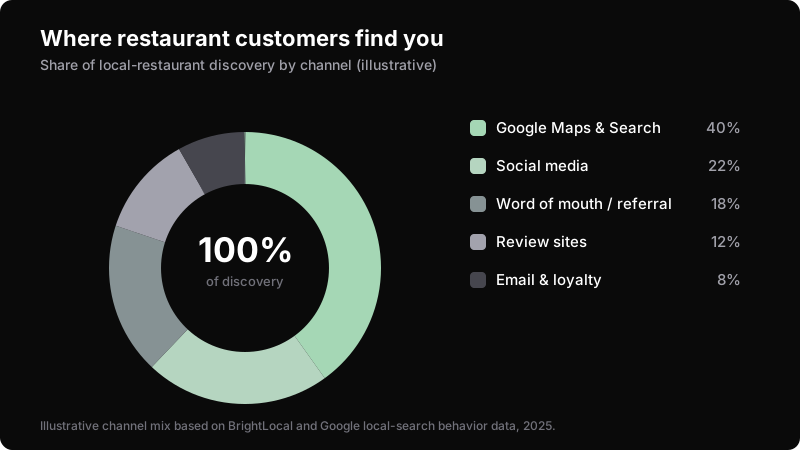
The highest-ROI restaurant marketing isn't a billboard or a paid ad. It's showing up when a hungry person nearby searches "restaurants near me." Nearly half of all Google searches have local intent, and BrightLocal's 2024 Local Consumer Review Survey found restaurants are the single most-searched local business category — more than doctors, hotels, or hair salons.
That's the whole game for a restaurant. People decide where to eat in the ten minutes before they're hungry. If your restaurant looks better than the place two blocks over — more reviews, better photos, an easy menu — you win the table. If it doesn't, you lose it, whether or not your food is better.
This guide is the hub. It covers the full restaurant marketing stack — local search, reviews, social, email, loyalty, delivery — as a connected system. Each section is a fast overview that links to a deeper playbook. Work top to bottom, or jump to the channel that's leaking the most customers.
Key Takeaways
- Nearly half of Google searches are local, and restaurants are the most-searched local category (BrightLocal, 2024)
- Your Google Business Profile is your highest-ROI channel — it's free and it feeds Maps, Search, and AI answers
- 88% of people trust recommendations from people they know above all advertising (Nielsen)
- Reviews are the tiebreaker: 76% of consumers regularly read them before choosing a local business (BrightLocal, 2024)
- Owned channels (Google Profile, email, loyalty) beat rented ones (third-party apps) on margin every time
What's the Highest-ROI Restaurant Marketing Channel?
Your Google Business Profile is the highest-ROI channel a restaurant has, full stop. It's free, it powers the Maps pin and the Search panel, and it's the first thing a nearby diner sees. Everything else — social, email, ads — is a supporting act. Get the profile right before you spend a dollar anywhere else.
Most restaurant marketing advice skips the boring, free thing and jumps to Instagram Reels. That's backwards. A diner searching "tacos near me" at 7 PM is ready to buy right now. A scroller watching a food video is entertainment, not intent. Both matter — but one fills tables tonight.
Here's how the main channels compare for a typical owner-operated restaurant. Cost, effort, and what each one is actually good for.
Restaurant Channel Comparison
| Channel | Cost | Effort | Best for |
|---|---|---|---|
| Google Business Profile | Free | Low | Getting found by nearby, ready-to-buy diners |
| Online reviews | Free | Medium (ongoing) | Winning the tiebreaker between you and competitors |
| Instagram / TikTok | Free–low | High (consistent) | Craving-building, discovery, staying top-of-mind |
| Email & SMS | Free–low | Medium | Repeat visits, event nights, slow-day fills |
| Loyalty program | Low | Medium | Turning first-timers into regulars |
| Third-party delivery | 15–30% per order | Low | Reach and convenience — at a steep margin cost |
| Paid local ads | Medium–high | Medium | Speeding up results once the free channels are dialed in |
The pattern is clear. The free, owned channels — your profile, reviews, email, loyalty — do the heavy lifting. Paid channels amplify what's already working. Never pay to send traffic to a weak profile or a page with two-star reviews.
If you only fix one thing this month, fix your Google Business Profile. It's the channel with the highest ratio of results to effort — and it costs nothing but an afternoon.
How Do Restaurants Show Up on Google Maps?
Restaurants show up on Google Maps through a fully completed, actively maintained Google Business Profile — the right category, real hours, a current menu, fresh photos, and steady reviews. Google ranks local results on relevance, distance, and prominence, and your profile is where you control two of those three.
Claim your profile at Google Business Profile if you haven't. Then treat it like your homepage, because for a restaurant, it basically is. More diners see your Google panel than ever visit your website.
The fundamentals that move you up the Map pack:
- Primary category. Pick the most specific one ("Neapolitan pizza restaurant," not "restaurant"). This single field heavily shapes what searches you appear for.
- Hours that are always right. Wrong holiday hours are the fastest way to a one-star review. Update them before every holiday.
- Photos, constantly. Profiles with fresh photos get more clicks and direction requests. Add a few every week — food, room, staff, exterior.
- Menu and attributes. Fill in the menu, price range, dietary options, and service attributes (dine-in, takeout, outdoor seating). These feed filtered searches like "vegan restaurants open now."
- Google Posts. Free mini-updates for specials and events. They keep the profile looking active.
This is the same local-SEO foundation any brick-and-mortar business needs. For the full local search playbook beyond restaurants, see our guide on social media marketing for small business, and for the restaurant-specific profile setup, the deep dive is Google Business Profile for restaurants.
One more thing worth doing: make sure your name, address, and phone number match exactly everywhere online — your site, Yelp, TripAdvisor, delivery apps. Inconsistent info confuses Google and splits your ranking signals.
How Do You Get More Restaurant Reviews?
You get more reviews by asking every happy guest, at the moment they're happiest, with a link that takes two taps. Reviews are the tiebreaker in restaurant decisions — BrightLocal's 2024 survey found 76% of consumers regularly read online reviews for local businesses, and star rating is the number-one factor they judge you on.
The math is simple and brutal. A restaurant with 4.6 stars and 400 reviews beats a 4.8-star place with 30 reviews almost every time. Volume plus recency signals "lots of people ate here recently and were happy." That's what a stranger deciding between two dinner spots wants to know.
What actually generates reviews:
- A QR code on the check and table tents. Point it straight at your Google review link. Remove every step you can.
- The server ask. "If you enjoyed it, a quick Google review really helps us." Trained, consistent, timed to a good moment.
- Reply to every review — good and bad. Responses signal you're paying attention, and they're a ranking and trust factor. Never argue with a bad one; apologize and offer to make it right.
- Never buy or gate reviews. Fake reviews and "leave 5 stars for a free app" violate Google's policies and can get you filtered or suspended.
The full step-by-step system — link setup, scripts, and handling negative reviews — is in our guide on how to get more Google reviews for your restaurant. Reviews compound: the more you have, the more you get, because you rank higher and get seen more.
Reputation isn't just Google anymore. Increasingly, AI assistants pull restaurant recommendations from review signals and structured data. Making your restaurant citable by tools like ChatGPT and Perplexity is a growing edge — more on that in how to get cited by ChatGPT and Perplexity.
Does Social Media Actually Fill Tables?
Social media fills tables indirectly — it builds cravings and keeps you top-of-mind, but it rarely converts a cold scroller into a same-night reservation. Its real job is discovery and desire. Someone sees your birria taco pull on TikTok, remembers you Friday, and searches your name. That search is where the table gets booked.
That's why you shouldn't judge social by likes. Judge it by whether people show up saying "I saw you on Instagram." For restaurants, short video is the format that travels furthest right now — a 15-second clip of food being made or plated outperforms polished ads on reach.
What works for restaurants specifically:
- Food-in-motion. Cheese pulls, sauce pours, the first cut. Movement and sound beat static plate shots.
- The people and the place. Diners connect with the chef, the line cooks, the regulars. Faces build the brand.
- Post at meal-decision times. Late morning and late afternoon, when "where should we eat?" is an active question.
- Consistency over virality. One good clip a day beats chasing one viral hit a month.
You don't need to be on every platform. Pick one — usually Instagram or TikTok — and be consistent. The tactical playbook is in restaurant social media marketing ideas, and if TikTok's your pick, TikTok marketing for small business covers the format without the dancing.
Word of mouth is still the strongest force in restaurant discovery, and social is word of mouth at scale. Nielsen found 88% of people trust recommendations from people they know above every other form of advertising. A guest tagging your restaurant in a story is worth more than any ad you could buy.
Should You Build an Email and SMS List?
Yes — email and SMS are the only channels you own outright, and for restaurants they're the cheapest way to fill a slow Tuesday. No algorithm decides who sees the message. You send "half-price wings tonight" and it lands. Social reach is rented; your list is owned.
The catch is collection. Restaurants have hundreds of customers a day and capture almost none of their contact info. Fix that, and you've built a channel you can turn on any night business is slow.
How restaurants build a list without being annoying:
- Wi-Fi sign-in. Trade guest Wi-Fi for an email. Low friction, high volume.
- Loyalty signup. The reward is the incentive to hand over a phone number.
- Reservation and online-order data. You already have it — make sure it flows into your list (with consent).
- A simple "get our specials" card with a QR code at the register.
SMS is the higher-intent sibling. Open rates dwarf email, but the bar for relevance is higher — people forgive a skippable email far more than an unwanted text. Use SMS for time-sensitive, genuinely valuable messages: tonight's special, a two-hour flash deal, "your table's ready."
The mechanics of turning a new subscriber into a repeat guest are the same as any business. Our email marketing for small business guide covers tools and deliverability, and the welcome email sequence that converts shows exactly how to greet a new subscriber so the first email earns the second visit.
How Do You Turn First-Timers Into Regulars?
You turn first-timers into regulars with a reason to come back before they've left — a loyalty program, a next-visit offer, or a reservation for the next event. Repeat customers are the cheapest revenue a restaurant has. You already paid to acquire them; a regular costs almost nothing to bring back.
The gap most restaurants miss: a great first meal isn't enough. Life is busy, options are endless, and a happy diner still forgets you exist by next week. Loyalty mechanics fight that forgetting.
What keeps guests coming back:
- A simple loyalty program. Digital punch card, points, or a members-only perk. Simple beats clever — people won't track a 7-tier system.
- A next-visit nudge. A "come back this week for a free dessert" offer handed out at checkout converts far better than a generic coupon later.
- Recognition. Regulars want to feel like regulars. Name, usual order, a comped coffee. Nothing scales trust like being remembered.
- Occasion marketing. Birthday and anniversary emails give a reason and a date to return.
Loyalty and email work as a pair. The loyalty program collects the contact info; email and SMS reactivate it. A member who hasn't visited in 60 days is a perfect target for a "we miss you" offer — and that reactivation costs pennies.
What About Promotions, Events, and Influencers?
Promotions, events, and influencer collaborations are accelerators — they work best layered on top of a solid profile, reviews, and a list, not as a substitute for them. A great event with no way to capture attendees' contact info is a one-night sugar high.
Use each for its strength:
- Promotions fill known slow periods. Tuesday-night deals, happy hours, prix-fixe weeks. Tie every promo to list signup so a one-time deal-seeker becomes a repeat guest.
- Events create reasons to visit and content to post. Trivia nights, tasting menus, live music, collaborations with a local brewery. Events are word-of-mouth engines.
- Influencer and UGC. A local food creator with 8,000 engaged local followers often beats a national name for a restaurant. Comp a meal, let them film, and repost their content. User-generated content — real guests tagging you — is more trusted than anything you produce yourself.
The thread connecting all three: capture the audience. Every promo, event, and influencer visit should feed your owned channels. Collect emails at the door, get the influencer to link your profile, turn event photos into a week of social posts. The event ends; the list is forever.
Don't run promotions so often they train customers to only visit on discount. The goal is filling genuinely slow times and acquiring contacts — not eroding your full-price business.
Third-Party Delivery vs Direct Ordering: Which Wins?
Direct ordering wins on margin; third-party delivery wins on reach. The right answer for most restaurants is both — use the apps for discovery, then work hard to convert those customers to your own ordering channel where you keep the full ticket.
Third-party platforms take a heavy cut, and they own the customer relationship. You get the order; they get the email, the data, and the next reorder. That's the trade for their reach and convenience.
Delivery Channels Compared
| Factor | Third-party apps | Direct (your own ordering) |
|---|---|---|
| Commission / fee | 15–30% per order | Payment processing only (~3%) |
| Customer data | Platform keeps it | You own it |
| Reach / discovery | High — built-in audience | Low — you drive the traffic |
| Setup effort | Low | Medium |
| Repeat-order margin | Erodes every order | Full margin, forever |
| Best used as | Acquisition channel | Retention channel |
The smart play is to treat delivery apps as a paid acquisition channel, not your core business. Use them to get discovered, then give customers reasons to order direct next time — an insert in the bag with a discount code for your own site, a loyalty perk that only works direct, better prices without the app markup.
Every order you shift from a 25%-commission app to your own channel is a roughly 22-point margin swing on that ticket. Over a year, for a busy restaurant, that's the difference between profit and break-even.
How Do You Measure Restaurant Marketing Results?
You measure restaurant marketing with a handful of numbers that connect to revenue: profile views and direction requests, review count and average rating, repeat-visit rate, and list size. Vanity metrics like follower count don't pay rent. Track what predicts butts in seats.
The metrics that actually matter:
- Google Business Profile insights. Searches, profile views, direction requests, calls. Rising direction requests mean more people are deciding to come.
- Review count and rating trend. Are you adding reviews every week and holding your rating? Both matter — volume and score.
- Repeat-visit rate. From your loyalty or POS data. The single best long-term health metric for a restaurant.
- List growth. Email and SMS subscribers added per week. Your owned audience, compounding.
- Cover counts by daypart. Which nights are slow, and did a promo or post move them?
You don't need a dashboard from day one. Check your Google Profile insights monthly, watch your review trend weekly, and track list growth. If those three are climbing, your marketing is working — the covers follow.
The point of measuring is to double down on what works and cut what doesn't. If Instagram takes ten hours a week and drives nothing, and reviews take one hour and fill tables, the math tells you where to spend your time.
Frequently Asked Questions
What's the cheapest way to market a restaurant?
Your Google Business Profile — it's free and it's the highest-intent channel you have. Claim it, pick a specific primary category, add fresh photos weekly, keep hours accurate, and reply to every review. Pair it with a steady stream of reviews from happy guests. Those two free tactics beat any paid campaign for an owner-operated restaurant, and they compound over time.
How many Google reviews does a restaurant need?
There's no magic number, but you want to out-review your direct competitors and keep reviews recent. A 4.5-plus rating with hundreds of reviews and new ones every week beats a perfect score with a handful. BrightLocal's 2024 data shows recency matters — reviews older than three months carry less weight with diners. Aim for a steady trickle, not a one-time push.
Is social media worth it for a small restaurant?
Yes, but as a discovery and craving-building channel, not a direct booking tool. Pick one platform — usually Instagram or TikTok — and post short food-in-motion videos consistently. Judge it by name searches and "I saw you online" mentions, not likes. If you only have time for one thing, though, fix your Google Business Profile and reviews first.
Should restaurants use third-party delivery apps?
Use them for reach, but treat them as an acquisition channel, not your core business. The 15–30% commission and the fact that the app owns your customer data make them expensive. Get discovered on the apps, then convert those customers to your own direct ordering with inserts, loyalty perks, and better prices. Every order shifted to direct is a big margin win.
How do I get more repeat customers at my restaurant?
Give guests a reason to return before they leave. A simple loyalty program, a next-visit offer at checkout, and an email or SMS list you can reactivate on slow nights. Repeat customers are your cheapest revenue — you already paid to acquire them. Recognition matters too: regulars who feel remembered come back more and spend more.
Sources
- BrightLocal, "Local Consumer Review Survey 2024," retrieved 2026-07-03, https://www.brightlocal.com/research/local-consumer-review-survey/
- Google, "Google Business Profile," retrieved 2026-07-03, https://www.google.com/business/
- Google, "Improve your local ranking on Google," retrieved 2026-07-03, https://support.google.com/business/answer/7091
- Nielsen, "Trust in Advertising," retrieved 2026-07-03, https://www.nielsen.com/insights/2021/trust-in-advertising/
- National Restaurant Association, "State of the Restaurant Industry," retrieved 2026-07-03, https://restaurant.org/research-and-media/research/industry-statistics/
- Toast, "Restaurant Marketing Statistics," retrieved 2026-07-03, https://pos.toasttab.com/blog/on-the-line/restaurant-marketing-statistics
- Sprout Social, "Social Media Statistics," retrieved 2026-07-03, https://sproutsocial.com/insights/social-media-statistics/
- OpenTable, "Restaurant Industry Resources," retrieved 2026-07-03, https://restaurant.opentable.com/resources/