By Pablo Bravo
Your welcome email is the highest-performing email you'll ever send. Omnisend's 2026 data shows welcome emails hit a 35.53% open rate and a 2.11% conversion rate — far above any regular campaign. The top 10% of welcome sequences earn $21.18 per email. And that first 48-hour window after signup? It's the most engaged a subscriber will ever be.
Most founders waste this window with a generic "Thanks for subscribing!" email. That's leaving money on the table. This guide gives you a 5-email welcome sequence framework with copy-paste templates you can set up in an afternoon.
If you're starting from scratch with email, read our email marketing guide for small business first. To sharpen the lines that get these emails opened, see our subject line formulas.
Key Takeaways
- Welcome emails convert at 2.11% with a 35.53% open rate (Omnisend, 2026)
- A 5-email sequence over 7 days covers delivery, story, value, proof, and pitch
- Delayed welcome emails lose 50%+ of their open rate vs instant delivery
- Each email should have exactly one job and one CTA
Why Do Welcome Emails Outperform Everything Else?
Welcome emails earn $2.65 per email on average, and the top 10% earn $21.18 per email (Omnisend, 2026). That's because subscribers have just raised their hand. They told you "I'm interested." Ignoring that signal — or wasting it — is the most expensive mistake in email marketing.

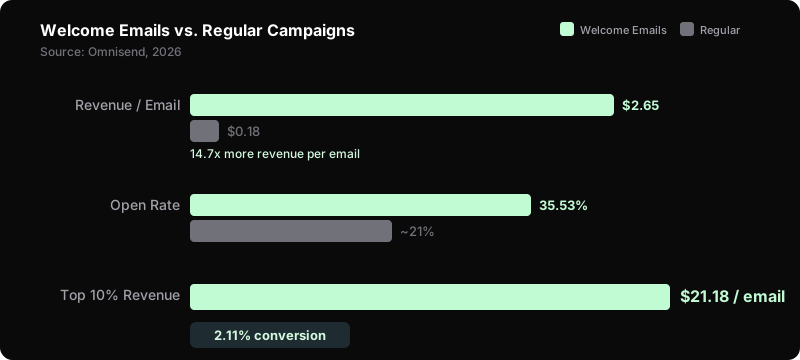
Here's why the math works so well for small businesses. Regular campaigns compete with 50+ other emails in someone's inbox. Your welcome email arrives at the exact moment they're thinking about you. That timing advantage compounds across a sequence.
Amy Porterfield, who built a $100M+ business through her email list, says her welcome sequence outperforms every launch campaign. "That first week is when someone cares most about what you have to say."
The data backs her up. Subject lines that promise a specific outcome see 20-30% higher open rates than generic welcomes (Campaign Monitor, 2026). And welcome sequences that include segmentation at signup measurably outperform generic ones. If you're still building the list this sequence feeds, our guide to growing a newsletter from 0 to 1,000 subscribers pairs well here.
One more thing: your welcome sequence sets your sender reputation. High engagement in those first emails tells Gmail and Yahoo that your subscribers want your messages. That reputation follows every email you send afterward.
The 5-Email Welcome Sequence Framework
Welcome sequences that deliver value before pitching earn 3-5x more revenue per subscriber than single-email approaches, according to Omnisend benchmarks. A structured 5-email flow over 7 days covers delivery, credibility, storytelling, social proof, and a soft CTA, each email with exactly one job.
This framework works for SaaS founders, newsletter creators, e-commerce stores, and service businesses. Each email has one job. One CTA. Nothing more.
Email 1: Deliver + Introduce (Send Immediately)
Job: Deliver what you promised and make a first impression.
Why immediately? Delayed welcome emails lose 50%+ of their open rate. Your subscriber is on your site right now, checking their inbox. Hit it within seconds.
Template:
Subject: Here's your [lead magnet name]
Hey [First Name],
Here's the [resource/discount/guide] you signed up for: [LINK]
Quick intro: I'm [Your Name]. I run [Company]. Every [frequency], I send [what they'll get] — [specific benefit].
One thing that makes us different: [one sentence about your unique angle].
Hit reply and tell me — what's your biggest challenge with [topic] right now?
[Your Name]
The reply question isn't just friendly. Replies signal engagement to inbox providers. They improve your deliverability for every future email.
Email 2: Your Best Content (Day 1)
Job: Prove you deliver real value.
Template:
Subject: The [topic] resource our readers love most
[First Name],
Yesterday I sent your [lead magnet]. Today I want to share the single most popular thing I've ever published:
[LINK to your best content piece]
It covers [specific outcome]. [One sentence about the result someone got from it.]
Worth 5 minutes of your time.
[Your Name]
Don't overthink this. Pick whatever got the best response — most shares, most replies, most traffic. If you're new and don't have data, pick whatever you're proudest of.
Email 3: Problem → Solution Story (Day 3)
Job: Build trust through a real story.
Subject: How I [solved specific problem]
[First Name],
When I started [Company], I struggled with [specific problem your audience has].
I tried [common solution that doesn't work]. Didn't work because [specific reason].
What actually worked: [your approach in 2-3 sentences].
The result: [specific metric or outcome].
If you're dealing with [problem] right now, here's the first step I'd take: [one actionable thing].
[Your Name]
Email 4: Social Proof + Quick Win (Day 5)
Job: Show results and deliver an easy win.
Subject: [Customer/Reader Name] did [result] in [timeframe]
[First Name],
[Customer Name] was in the same spot you might be in right now: [their starting situation].
After [what they did], they [specific result with numbers].
Here's a quick win you can try today (takes under 5 minutes):
- [Step 1]
- [Step 2]
- [Step 3]
Let me know how it goes.
[Your Name]
No testimonial yet? Use your own results. Or reference a tactic from your best content that got someone a result.
Email 5: Soft CTA + What to Expect (Day 7)
Job: Make a gentle pitch and set expectations.
Subject: What comes next
[First Name],
Over the past week, I've shared [summary of what you sent].
Going forward, you'll hear from me every [frequency] with [what they'll get].
If you want to go deeper, here's what I offer: [one sentence about your product/service and who it's for].
[CTA button or link]
No pressure. The free content keeps coming either way.
[Your Name]
This is a soft pitch, not a hard sell. The subscriber has gotten 4 emails of pure value. They've seen proof. Now you've earned the right to mention what you sell — once.
Subject Line Formulas for Welcome Emails
Welcome email subject lines that promise a specific deliverable ("Here's your template") achieve 20-30% higher open rates than vague alternatives like "Welcome aboard," according to Campaign Monitor benchmarks. Clarity beats cleverness in the first email your subscriber ever receives.
Subject lines with specific outcomes get 20-30% higher open rates than generic alternatives. Here are formulas that work specifically for welcome sequences — for the full set, see our 15 subject line formulas.
Email 1 (Delivery):
- "Here's your [resource name]" — direct, no mystery needed
- "Your [resource] is ready" — implies action taken on their behalf
Email 2 (Best content):
- "The [topic] guide our readers share most"
- "This helped [number] founders with [problem]"
Email 3 (Story):
- "How I went from [before] to [after]"
- "The [topic] mistake that cost me [specific thing]"
Email 4 (Social proof):
- "[Name] hit [result] in [timeframe]"
- "A 5-minute fix for [specific problem]"
Email 5 (CTA):
- "What comes next"
- "One more thing before regular emails start"
Avoid: "Welcome to our newsletter!" (boring), "You won't believe..." (clickbait), all caps (spam trigger), emojis in every subject (pattern that screams marketing).
5 Mistakes That Kill Welcome Sequence Conversions
Delayed welcome emails lose 50%+ of their open rate compared to instant delivery, and broken lead magnet links cause permanent subscriber loss (Klaviyo, 2026). Timing errors, premature pitches, and cluttered CTAs are the most common conversion killers in automated sequences.
1. Selling too hard, too fast. Your first email shouldn't pitch your product. Deliver value first. Earn trust. Email 5 is early enough for a soft CTA.
2. No personality. Generic corporate copy gets ignored. Write like you'd talk to a founder at a coffee shop. Use contractions. Use your real name as the sender.
3. Too many CTAs per email. Each email gets one link. One action. When you give people three choices, they pick none.
4. Broken or missing delivery. If Email 1 promises a PDF and the link is broken, you've lost that subscriber permanently. Test every link before going live.
5. Wrong timing. Sending Email 1 six hours after signup cuts your open rate in half. Set your automation to trigger instantly. Then space remaining emails 1-2 days apart.
How Should You Time Your Welcome Sequence?
Instant delivery for Email 1 is non-negotiable: delayed sends lose over half their opens. GetResponse's 2024 benchmarks found that Tuesdays at 10 AM produce peak engagement for scheduled emails. For welcome sequences, every-other-day spacing outperforms daily sends for most small businesses.
The research is clear on timing. Instant delivery for Email 1 is non-negotiable. After that, every-other-day spacing outperforms daily sends for most small businesses.
Recommended Schedule
| Day | Time | |
|---|---|---|
| Email 1: Deliver + Intro | Immediately | Triggered on signup |
| Email 2: Best Content | Day 1 | 10 AM subscriber's local time |
| Email 3: Story | Day 3 | 10 AM subscriber's local time |
| Email 4: Proof + Quick Win | Day 5 | 10 AM subscriber's local time |
| Email 5: Soft CTA | Day 7 | 10 AM subscriber's local time |
GetResponse's 2024 benchmarks found that Tuesdays at 10 AM produce the highest engagement. But for welcome sequences, the day-of-week matters less than the spacing from signup. Your automation handles the timing — you just set the delays.
After the Welcome Sequence
When the 5-email sequence ends, move subscribers into your weekly nurture flow. One email per week. Alternate between tips, stories, and curated roundups — our lazy content marketing guide shows how to source that content without burning out. Not sure whether that ongoing flow should be a newsletter or an outreach engine? Our breakdown of cold email vs newsletter clarifies which fits your goals. Don't leave a gap — subscribers who go from 5 emails in a week to silence for a month disengage fast.
If someone doesn't open any of your first 5 emails, tag them as cold. Wait 30 days, then trigger a re-engagement sequence.
Frequently Asked Questions
How many emails should a welcome sequence have?
Five emails over 7 days hits the sweet spot for most small businesses. Fewer than three doesn't build enough trust. More than seven risks fatigue before your regular cadence starts. Omnisend's data shows the revenue impact drops off sharply after email five.
What's a good conversion rate for a welcome sequence?
The average welcome email converts at 2.11% with a 35.53% open rate (Omnisend, 2026). Top performers hit $21.18 revenue per email. If you're below a 1% conversion rate, check your offer relevance and whether Email 1 delivers what you promised.
Should I use plain text or designed emails?
Plain text outperforms designed emails for most B2B and SaaS welcome sequences. It feels personal, loads faster, and avoids rendering issues. For e-commerce, a branded template with product images works better. Test both — your audience decides.
When should I start selling in a welcome sequence?
Email 5 (Day 7) is the earliest for a soft pitch. You've delivered value in four emails. You've built trust with a story and social proof. Pitching in Email 1 or 2 is the fastest way to earn unsubscribes.
Can I use AI to write my welcome emails?
Use AI for drafts and subject line variants, but rewrite in your voice (our Claude AI prompts for marketers help here). AI-generated welcome emails read like AI — and this is the one place where personality matters most. Your subscribers are forming a first impression. Make it sound like a human wrote it, because a human should.
Sources
- Omnisend, "Email Marketing Statistics," retrieved 2026-06-29, https://www.omnisend.com/blog/email-marketing-statistics/
- GetResponse, "Email Marketing Benchmarks," retrieved 2026-06-29, https://www.getresponse.com/resources/reports/email-marketing-benchmarks
- Amy Porterfield, retrieved 2026-06-29, https://www.amyporterfield.com/
- Campaign Monitor, "Email Marketing Benchmarks," retrieved 2026-06-29, https://www.campaignmonitor.com/resources/guides/email-marketing-benchmarks/
- Klaviyo, "Email Marketing Benchmarks 2026," retrieved 2026-06-29, https://www.klaviyo.com/uk/blog/email-marketing-benchmarks-open-click-and-conversion-rates