By Pablo Bravo
Growing a newsletter from zero to 1,000 subscribers takes most founders 6 to 12 months of consistent work — and you don't need ads or an existing audience to do it. The reason it's worth the grind: email marketing returns an average of $36 for every $1 spent (Litmus, 2024), the highest ROI of any channel. No algorithm sits between you and your readers. You own the list.
The problem is that "just start a newsletter" advice skips the hard part — where the first subscribers actually come from when nobody knows you exist. This guide walks channel by channel through what works at each stage, with a realistic 12-month growth curve so you know whether you're on track or falling behind.
If you're brand new to email, start with our email marketing guide for small business for the setup basics. This guide assumes you have a tool picked and focuses only on growth.
Key Takeaways
- Email returns an average $36 per $1 spent — the highest ROI of any marketing channel (Litmus, 2024)
- Most newsletters reach 1,000 subscribers in 6-12 months of consistent publishing, not weeks
- Your owned website plus a lead magnet is the highest-converting acquisition channel — dedicated landing pages convert at 20%+ (HubSpot, 2024)
- Referral loops compound growth: word-of-mouth drove the early growth of newsletters like Morning Brew to millions of readers (beehiiv, 2024)

Why is 1,000 subscribers the milestone that matters?
A thousand subscribers sounds arbitrary. It isn't. It's the point where a newsletter stops being a hobby and starts behaving like an asset.
At 1,000 engaged subscribers, you have enough people to get real feedback, test offers, and see statistically meaningful open and click patterns. Send to 50 people and one reply feels like a fluke. Send to 1,000 and 30 replies tell you something true about what your audience wants.
It's also the threshold where compounding kicks in. Kevin Kelly's 1,000 True Fans essay made the case that a creator needs roughly a thousand people who care to build something sustainable. A newsletter is the cleanest way to collect and reach those fans directly.
And 1,000 is where monetization becomes plausible. Sponsors, paid tiers, and product launches all need an audience floor. Below 1,000 you're building. At 1,000 you have leverage.
The number is a checkpoint, not a finish line. But it's the right first goal because it's big enough to matter and small enough to reach without ads.
How long does it take to reach 1,000 subscribers?
Honestly? Longer than you want. Expect 6 to 12 months if you publish consistently and actively promote. If you only publish and never promote, plan on 18 months or more — or never.
The growth curve isn't linear. Your first 100 subscribers are the slowest and most manual. The jump from 100 to 500 speeds up as word spreads and your content library gives search and social something to find. The 500-to-1,000 stretch is often the fastest, because referrals and compounding channels finally have a base to work from.
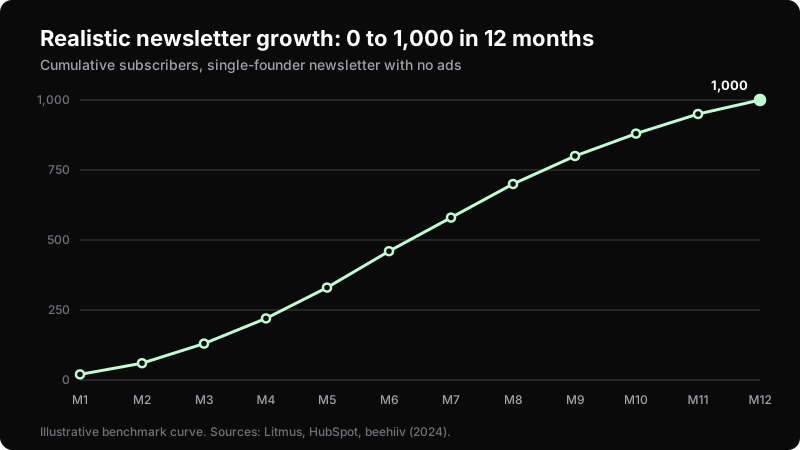
Here's a realistic month-by-month target to benchmark against. If you're ahead of it, great. If you're behind, look at which channel you're neglecting.
| Month | Cumulative subscribers | Primary growth driver |
|---|---|---|
| 1 | 20 | Personal network, manual invites |
| 2 | 60 | Communities, first content pieces |
| 3 | 130 | Lead magnet + owned landing page |
| 4 | 220 | Social posts, consistent publishing |
| 5 | 330 | Reddit / niche communities |
| 6 | 460 | Cross-promotion, recommendations |
| 7 | 580 | SEO content starts indexing |
| 8 | 700 | Partnerships, guest features |
| 9 | 800 | Referral loop kicks in |
| 10 | 880 | Compounding from all channels |
| 11 | 950 | Referrals + search compounding |
| 12 | 1,000 | Sustained multi-channel flywheel |
Two things stall this curve: inconsistent publishing and treating email as write-and-forget. The founders who hit 1,000 fastest ship on a fixed schedule and spend at least half their time on distribution, not writing.
What's the fastest way to get your first 100 subscribers?
Your first 100 come from people, not algorithms. This is the manual, unscalable phase — and skipping it is why most newsletters die at 12 subscribers.
Before you launch, set up a simple landing page that explains what the newsletter is, who it's for, and what someone gets by subscribing. One clear promise beats a clever tagline. Dedicated landing pages convert far better than a sidebar signup box — HubSpot reports well-optimized landing pages can convert north of 20% of visitors.
Then go get the first 100 by hand:
- Your existing network. Text, DM, and email people who'd genuinely find it useful. Not a broadcast — individual messages. This alone can get you 20-40 subscribers in a week.
- A pre-launch waitlist. Announce it's coming before it's ready. Scarcity and "early reader" framing pull sign-ups from people who'd otherwise scroll past.
- Communities you're already in. Slack groups, Discord servers, forums where your topic lives. Share the newsletter where self-promotion is allowed, and answer questions where it isn't.
- Your other profiles. Add the link to your X bio, LinkedIn, email signature, and GitHub. Free, permanent, and most people never bother.
The goal of the first 100 isn't scale. It's proof. A hundred people who opted in tell you the promise resonates. Our guide on organic user growth for founders who hate marketing covers this hand-to-hand phase in more depth.
Which channels actually grow a newsletter?
Past 100 subscribers, you need channels that bring strangers. Not every channel works at every stage. Here's what actually moves the number, roughly in the order you should add them.
Your owned site plus a lead magnet
This is the highest-converting channel you control. A lead magnet — a checklist, template, mini-course, or swipe file — gives people a concrete reason to trade their email. "Subscribe for updates" converts poorly. "Get the 12-month growth tracker" converts.
Put the opt-in everywhere on your site: inline in posts, an exit popup, a footer, a dedicated page. Every published article becomes a permanent subscriber magnet once it ranks. This is the slow-but-compounding core of newsletter growth.

Social platforms
Social is where you find people before they know they need you. Pick one platform where your audience already is — X, LinkedIn, or a video platform — and post consistently. Repurpose your newsletter content into native posts, then link to the full version with a subscribe prompt.
Don't spread across five platforms at once. One channel done well beats five done badly. Our social media marketing guide covers how to pick and work a single channel.
Communities like Reddit
Niche communities are underrated for newsletter growth because the people there are self-selected by interest. The catch: you can't spam. You earn subscribers by being genuinely useful first, then linking when it's relevant and allowed.
Reddit especially rewards contribution over promotion. Answer questions thoroughly, reference your newsletter only when it truly helps, and let curiosity do the rest. Our Reddit marketing tactics guide breaks down how to do this without getting banned.
Cross-promotion and recommendations
Once you have a few hundred subscribers, cross-promotion becomes possible. You recommend another newsletter to your readers, they recommend yours to theirs. Both lists grow, no money changes hands.
Newsletter platforms have made this nearly automatic. beehiiv and Substack both have recommendation networks that surface your newsletter to readers of similar publications at the moment they subscribe. This is one of the fastest-growing acquisition channels for newsletters today.
Partnerships and guest features
Guest posts, podcast appearances, and joint webinars put you in front of an audience someone else spent years building. The trade is your effort for their reach. A single guest essay on a well-read publication can bring more subscribers than a month of solo posting — if you include a clear, relevant subscribe link.
The pattern across all five channels: no single one gets you to 1,000. The flywheel does. Each channel feeds the next, and the compounding is what carries you through the back half of the curve.
How do lead magnets and referral loops compound growth?
Two mechanics turn linear effort into compounding growth: the lead magnet and the referral loop.
A lead magnet raises your conversion rate on every visitor you already get. If your site converts at 2% and a good lead magnet lifts that to 8%, you just quadrupled subscribers from the same traffic. Nothing else you do scales that cleanly. The best lead magnets solve one specific, urgent problem your target reader has right now — not a 90-page ebook nobody finishes.
A referral loop turns subscribers into a growth channel. You ask existing readers to share, and reward them when friends subscribe. This is how newsletters like Morning Brew grew — beehiiv documents word-of-mouth referral programs driving a large share of early newsletter growth. Every new subscriber becomes a potential source of the next one.
Referral loops only work above a base — roughly a few hundred engaged subscribers — because you need enough people sharing for the math to compound. Add the referral mechanic once you clear 300 or so, not on day one.
The loop and the magnet stack. The magnet improves how many visitors convert; the referral loop improves how many subscribers bring more. Together they're why the 500-to-1,000 stretch moves faster than 0-to-100.
How do you keep growth from leaking through the bottom?
Growth is meaningless if subscribers quit as fast as they arrive. Retention and deliverability are the floor under everything else.
Start with the welcome sequence. It's the highest-engagement moment you'll ever have with a subscriber, and welcome emails see the strongest open and conversion rates of any email type. A new subscriber who gets a great first impression stays; one who gets silence or a hard pitch leaves. Our welcome email sequence guide gives you a copy-paste framework.
Then protect deliverability. If your emails land in spam, your growth leaks invisibly. Engagement is the biggest signal to Gmail and Yahoo that your mail belongs in the inbox — so getting opens and replies early matters. Sharpening your subject lines directly lifts opens, which lifts deliverability, which lifts every future send.
A few retention basics that keep the bottom from leaking:
- Publish on a predictable schedule. Erratic sending trains people to ignore you. Consistency trains them to expect you.
- Prune cold subscribers. Counterintuitive, but removing people who never open improves your deliverability and your real engagement rate.
- Deliver on the promise every issue. The reason they subscribed is the reason they stay. Drift from it and unsubscribes climb.
Sustainable content matters here too — you can't retain readers if you burn out and stop publishing. Our lazy content marketing guide shows how to keep shipping without torching your evenings. And if you're weighing email against other outreach, our comparison of cold email vs newsletter covers where each one fits.
When retention holds, growth compounds. When it leaks, you're pouring water into a bucket with a hole. Fix the hole first.
Frequently Asked Questions
How long does it realistically take to get 1,000 newsletter subscribers?
Most founders reach 1,000 subscribers in 6 to 12 months of consistent publishing plus active promotion. The first 100 are the slowest because they're manual. Growth accelerates after month six as content indexes, referrals kick in, and multiple channels compound. If you only publish without promoting, expect 18 months or longer.
Do I need a lead magnet to grow a newsletter?
Not to start, but it dramatically improves your conversion rate. "Subscribe for updates" converts poorly; a specific lead magnet like a checklist or template converts far better on the same traffic. Dedicated landing pages with a clear offer can convert 20%+ of visitors (HubSpot, 2024). Add one as soon as you know your audience's most urgent problem.
What's the best channel to grow a newsletter with no audience?
Start with your existing network and communities you're already in for the first 100, then add your owned site plus a lead magnet as the compounding core. Cross-promotion and platform recommendation networks (beehiiv, Substack) are the fastest channels once you have a few hundred subscribers. No single channel gets you to 1,000 — the flywheel does.
Should I use Substack, beehiiv, or ConvertKit?
All three grow newsletters well; pick based on your goal. Substack and beehiiv have built-in recommendation networks that help discovery early. Kit (ConvertKit) offers deeper automation and lead-magnet delivery for creators who want more control. The tool matters less than consistent publishing and promotion — switching platforms won't fix a growth problem caused by not promoting.
How often should I send my newsletter to grow fastest?
A predictable schedule beats a frequent one. Weekly is the most common cadence for growing newsletters because it's sustainable and keeps you top of mind without fatiguing readers. Erratic sending hurts both retention and deliverability. Pick a frequency you can hold for a year, then never miss it — consistency compounds far more than volume.
Sources
- Litmus, "Email Marketing ROI: What Every Marketer Needs to Know," retrieved 2026-07-03, https://www.litmus.com/resources/email-marketing-roi
- HubSpot, "Marketing Statistics, Trends & Data," retrieved 2026-07-03, https://www.hubspot.com/marketing-statistics
- beehiiv, "beehiiv Blog — Newsletter Growth," retrieved 2026-07-03, https://blog.beehiiv.com/
- Kit (ConvertKit), "Creator Marketing Platform," retrieved 2026-07-03, https://kit.com/
- Kevin Kelly, "1,000 True Fans," retrieved 2026-07-03, https://kk.org/thetechnium/1000-true-fans/
- Substack, "Grow — Substack Resources," retrieved 2026-07-03, https://substack.com/grow
- Omnisend, "Email Marketing Statistics," retrieved 2026-07-03, https://www.omnisend.com/blog/email-marketing-statistics/
- Backlinko, "Email Marketing Statistics," retrieved 2026-07-03, https://backlinko.com/email-marketing-stats