By Pablo Bravo
Here's the verdict up front: if you need revenue or validation this month, start with cold email. If you're building a durable audience that compounds, start a newsletter. They solve different problems.
Cold email is a hunting tool. You pick targets, send, and can book a call within days. Backlinko's study of 12 million cold emails found an average reply rate of 8.5% (Backlinko, 2024). That's slow demand you can turn on this week.
A newsletter is a farming tool. It's slower to start but pays back for years. Email marketing returns about $36 for every $1 spent (Litmus, 2024). The catch: that ROI assumes you've already built the list.
Most founders don't need to choose forever. You start with one, then add the other. This guide shows which to pick first.
Key Takeaways
- Cold email wins on speed — you can book calls within days, with an 8.5% average reply rate (Backlinko, 2024)
- Newsletters win on compounding — email returns ~$36 per $1 spent, but only after you build the list (Litmus, 2024)
- Cold email carries legal and deliverability risk; opt-in newsletters are safer by design
- Pick by goal: need sales now = cold email; building an audience = newsletter
What's the Difference Between Cold Email and a Newsletter?
The difference is consent, and it drives everything else. A cold email goes to someone who never asked to hear from you. A newsletter goes to people who opted in. Cold email is one-to-one outreach at small scale: you research a target, personalize a short pitch, and ask for a specific outcome like a call or a demo. Intent is transactional, and you want something now. A newsletter is one-to-many broadcast to a permission-based list. People subscribe because they want your content, so intent is relational. You give value repeatedly, and that trust converts to sales later. With over 4.4 billion email users worldwide, both formats reach people where they already are (Statista, 2024). One is a conversation you start. The other is an audience that comes to you.

Cold email rewards precision. A short, researched pitch to the right person beats a generic blast to a thousand. For the full playbook, see our cold email guide that gets replies.
A newsletter rewards consistency. One issue rarely sells; the tenth one does, because trust stacks. If you're weighing email broadly, start with our email marketing guide for small business.
Which Gets Results Faster?
Cold email is faster to first result, and it's not close. You can send 30 personalized emails today and have replies tomorrow, because there's no audience to build first. A newsletter has a cold-start problem: an empty list emails nobody. You have to attract subscribers before a single send matters, and that takes months of consistent publishing. Backlinko's data shows an 8.5% average reply rate on cold email, with follow-ups lifting responses by 65.8% (Backlinko, 2024). That's demand you can generate this week. But speed cuts both ways. Cold email results stop the day you stop sending; it's a faucet, not a well. A newsletter is the opposite: slow to fill, then it flows on its own. Our guide on growing a newsletter from 0 to 1,000 subscribers covers that grind.

The chart below scores both channels across the five dimensions that matter most to a founder deciding where to spend the next 90 days.
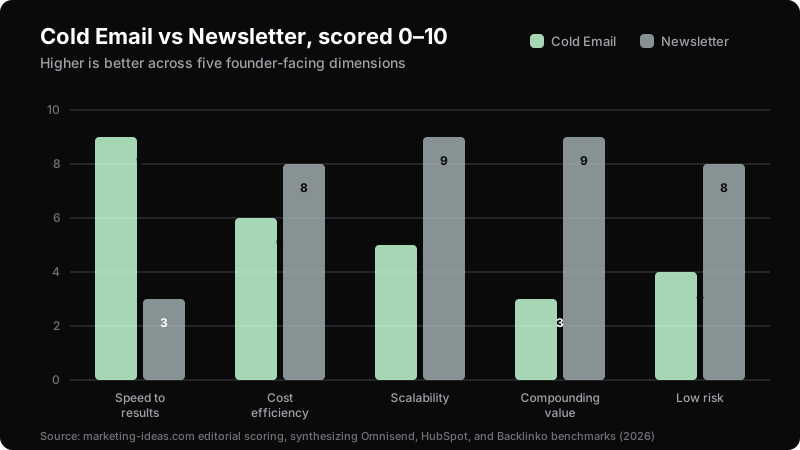
Cold email spikes on speed. Newsletters win on scalability, compounding value, and risk. Neither is "better" — they peak at different jobs.
Head-to-Head Comparison
| Dimension | Cold Email | Newsletter |
|---|---|---|
| Intent | Transactional — start a conversation | Relational — nurture an audience |
| Consent | None (recipient never opted in) | Opt-in (subscriber asked to hear from you) |
| Speed to first result | Days | Months (build list first) |
| Cost & tooling | Sending tool + verified list ($50–200/mo) | ESP, often free under 1,000 subs |
| Scalability | Caps on deliverability and reputation | Scales with content, not send volume |
| Compounding value | Low — stops when you stop | High — list is an owned asset |
| Legal exposure | CAN-SPAM + GDPR consent risk | Lower with proper opt-in |
| Best for | Booking sales calls, B2B validation | Building product-led demand, authority |
How Do Cold Email and Newsletters Compare on Cost and Scale?
Both start cheap, but you're paying for different things. Cold email costs money to run safely: you need a sending tool, a warmed-up domain, and verified email addresses so you don't burn your reputation. Budget $50–200 a month for tooling and list data. The real cost, though, is time, because every good cold email is researched and personalized. A newsletter is nearly free to send. Most email service providers, like Kit or Mailchimp, are free under 1,000 subscribers, so your only cost is the hours to write something worth opening. Mailchimp reports an average email open rate of 42.7% across industries (Mailchimp, 2024). Scale is where they split hardest. Cold email hits a ceiling: send too many and inbox providers throttle you. A newsletter scales with content quality, not raw volume.
One good newsletter issue reaches 100 or 100,000 people at the same effort. Cold email can't say that: doubling your reach means doubling your sending risk. Our lazy content marketing guide shows how to feed the newsletter machine without burning out.
The honest tradeoff on cost is time-shape. Cold email spends time upfront, per email, forever. A newsletter spends time upfront, then the same words keep working. That's the difference between billing hourly and building equity.
What About Deliverability and the Law?
This is where founders get burned, so read carefully. Cold email is legal in the US, but only with rules. CAN-SPAM allows unsolicited email, yet you must include a real physical address, an honest subject line, and a working unsubscribe link. Penalties run up to $53,088 per email for violations (FTC, 2024), so ignoring the rules gets expensive fast. The EU is stricter. Under GDPR, marketing email generally requires prior consent, and cold outreach to EU consumers is risky (GDPR.eu). B2B cold email has more room, but the safe move is to keep volumes low and targeting tight. Deliverability is the other trap: cold email fights spam filters constantly, and one bad campaign can blacklist your domain. That's why serious senders use a separate sending domain, never their main one.

Newsletters sidestep most of this. Subscribers opted in, so filters trust you more. Your job is keeping engagement high, which our welcome email sequence guide helps with from the first send.
The rule of thumb: cold email risk is legal and technical, and it lands hard and fast. Newsletter risk is behavioral and slow, and it mostly shows up as unsubscribes when you get boring.
Which Compounds and Which Carries More Risk?
A newsletter is an asset you own; a cold email campaign is an expense you repeat. Every subscriber you add stays on your list, so send after send, that audience compounds. HubSpot found email remains one of the highest-ROI channels marketers use (HubSpot, 2024), and a 5,000-person list is a moat competitors can't copy overnight. Cold email doesn't compound. Last month's replies don't help this month's numbers, so you're always starting the count over. It's effective, but it's a treadmill. Risk mirrors this pattern exactly. Cold email risk is concentrated and immediate: domain reputation, legal exposure, and prospect annoyance all hit at once. Newsletter risk is diffuse and slow, mostly the risk of quietly boring people until they unsubscribe. For a founder, the tradeoff is blunt: cold email buys speed at the cost of fragility, and a newsletter buys durability at the cost of patience.
There's a second-order effect worth naming. A cold email that lands can become a subscriber, and a subscriber can become a case study you cold-email other prospects about. The channels feed each other when you run them together, which is exactly why the sequencing question below matters more than the "which is better" question.
Which Should You Pick by Goal, Stage, and List Size?
Match the channel to your situation, not to a general rule. Your goal, your stage, and your existing list size decide the answer more than any benchmark does. A pre-launch founder with no audience and a target account list should hunt with cold email. A founder with steady traffic and a content habit should farm with a newsletter. And a founder with an existing list of even 200 warm contacts already has a newsletter seed worth watering. The matrix below maps common situations to a first move, so you can find your row instead of guessing. Email still returns roughly $36 per $1 once a list exists (Litmus, 2024), but that number is theoretical until subscribers show up. Read the matrix as "what to start this week," not "what to do forever."
Decision Matrix
| Your situation | List size | Start with | Why |
|---|---|---|---|
| Pre-revenue, need to validate a B2B idea | 0 | Cold email | Direct conversations beat guessing; feedback in days |
| Need paying customers in 30–60 days | 0–100 | Cold email | Fastest path from zero to a booked call |
| Have a clear target account list | Any | Cold email | Precision outreach converts researched prospects |
| Steady blog or social traffic already | 0–500 | Newsletter | Capture attention you're already earning |
| Product-led or content-led business | Any | Newsletter | Buyers research before they buy; nurture wins |
| Already have warm contacts or past buyers | 200+ | Newsletter | The list exists; start compounding it now |
| Want both revenue now and an audience later | 0 | Cold email first, newsletter second | Sequence them by stage |
Concrete scenarios
Scenario 1: solo B2B SaaS, pre-launch, no audience. Start with cold email. You need to know if the problem is real and who'll pay, and 30 sharp emails to target roles get you honest answers this week. Fold the best replies into a landing page, then start a newsletter once traffic trickles in. Pair the outreach push with our first 100 users guide.
Scenario 2: creator or indie hacker with a small following. Start a newsletter. You already earn attention on social, but you rent that audience from an algorithm. A newsletter converts rented reach into an owned list that no platform can throttle. Feed it with the tactics in our SaaS marketing hacks for founders.
Scenario 3: service business with past clients. Start a newsletter, then layer cold email. Your old clients are a warm list that compounds from day one. Use cold email in parallel to reach lookalike prospects while the newsletter keeps existing relationships alive.
Which Should You Start First?
Match the channel to your actual goal, and the choice gets simple. Start with cold email if you need revenue in the next 30–60 days, you're validating a B2B product, you have a clear target list, or you can handle rejection and iterate fast. Cold email is the fastest path from zero to a booked call, and it's how many B2B founders land their first ten customers. Start with a newsletter if you're building a product-led or content-led business, your buyers research before they buy, you can publish consistently for 3–6 months, or you want an audience that isn't rented from an algorithm. The honest sequence for most founders is both, in order: start with cold email to get first customers and learn what resonates, then write a newsletter that turns strangers into subscribers. Email's ~$36-per-$1 return only kicks in once that list exists (Litmus, 2024).
Start with cold email if:
- You need revenue or paying customers in the next 30–60 days
- You're validating a B2B product and need direct conversations
- You have a clear target list — specific companies or roles
- You can handle rejection and iterate on messaging fast
Start with a newsletter if:
- You're building a product-led or content-led business
- Your buyers research before they buy (most B2B and prosumer)
- You can commit to publishing consistently for 3–6 months
- You want an owned audience that isn't rented from an algorithm
You don't pick one for life. You sequence them by stage. Good subject lines matter for both — steal formulas from our subject line guide.
Frequently Asked Questions
Is cold email legal?
In the US, yes, under CAN-SPAM — if you include a physical address, an honest subject line, and a working unsubscribe link. Penalties reach $53,088 per email for violations (FTC, 2024). In the EU, GDPR requires consent for most marketing email, so cold outreach to EU consumers is risky. Keep B2B volumes low and targeting tight.
Can I do both cold email and a newsletter at the same time?
Yes, and many founders do. Cold email books deals now while your newsletter compounds in the background. Just keep them on separate sending domains. Cold email can hurt your domain reputation, and you don't want that bleeding into the newsletter your subscribers actually asked for.
Which one is cheaper to start?
A newsletter, narrowly. Most email platforms are free under 1,000 subscribers, so your only cost is the time to write. Cold email needs a sending tool, a warmed domain, and verified list data — roughly $50–200 a month. Both are cheap compared to paid ads. The bigger cost for either is your time.
How fast can cold email get results?
Days. You can send 30 personalized emails today and see replies tomorrow. Backlinko's data shows an 8.5% average reply rate, and follow-ups lift responses by 65.8% (Backlinko, 2024). A newsletter, by contrast, takes months — you have to build the list before a single send moves any number.
Do newsletters actually make money?
Yes, but indirectly and over time. Email marketing returns about $36 per $1 spent (Litmus, 2024). A newsletter rarely sells on the first email. It builds trust across many sends, then converts through product launches, affiliate links, or paid tiers. The value is the owned relationship, not any single send.
Sources
- Backlinko, "We Analyzed 12 Million Cold Emails," retrieved 2026-07-03, https://backlinko.com/cold-email-study
- Litmus, "Email Marketing ROI," retrieved 2026-07-03, https://www.litmus.com/resources/email-marketing-roi
- HubSpot, "Email Marketing Statistics," retrieved 2026-07-03, https://blog.hubspot.com/marketing/email-marketing-stats
- Mailchimp, "Email Marketing Benchmarks," retrieved 2026-07-03, https://mailchimp.com/resources/email-marketing-benchmarks/
- Statista, "Number of E-mail Users Worldwide," retrieved 2026-07-03, https://www.statista.com/statistics/255080/number-of-e-mail-users-worldwide/
- Omnisend, "Email Marketing Statistics," retrieved 2026-07-03, https://www.omnisend.com/blog/email-marketing-statistics/
- FTC, "CAN-SPAM Act: A Compliance Guide for Business," retrieved 2026-07-03, https://www.ftc.gov/business-guidance/resources/can-spam-act-compliance-guide-business
- GDPR.eu, "Email Encryption and Marketing Consent," retrieved 2026-07-03, https://gdpr.eu/email-encryption/
- Kit (ConvertKit), "Creator Newsletter Platform," retrieved 2026-07-03, https://kit.com/