By Pablo Bravo
Businesses that blog get about 55% more website visitors than those that don't, according to HubSpot's marketing research. But traffic isn't automatic. Ahrefs studied over a billion pages and found 90.63% get zero organic traffic from Google. The difference isn't how often you post. It's whether each post answers something a real person is searching for.
So the problem was never "what do I write about." It's "what do I write about that someone actually wants." This guide fixes both. You get a five-part framework to generate ideas on demand, then 50 concrete post ideas grouped by industry — restaurants, trades, health, professional services, retail, SaaS, and real estate.
If you already have posts sitting in a drafts folder, our lazy content marketing guide shows how to ship them without burning out. This guide is about filling the folder in the first place.
Key Takeaways
- 90.63% of pages get no organic Google traffic — topic choice matters more than post count (Ahrefs)
- The best ideas come from five sources: search intent, customer questions, seasonal hooks, comparisons, and local angles
- Match the post type to a funnel stage — how-tos pull traffic, comparisons capture buyers
- Consistency beats volume: one useful post a week outranks ten thin ones a month
Why Do Most Small Business Blogs Fail?
Most small business blogs fail for one reason: they write for themselves, not for search. A post titled "Exciting News From Our Team" helps nobody find you. Nobody types that into Google.
The Ahrefs data is blunt. Over 90% of pages get no search traffic at all, mostly because they target keywords with zero demand or none at all. You can write the best post on Earth about a topic nobody searches for, and it'll sit at zero.
The second failure is inconsistency. Founders publish four posts in January, then go quiet until June. Google rewards steady output and topical depth. A blog that stops looks abandoned to both readers and crawlers.
The fix is a system that ties every idea to real search demand and keeps the pipeline full. That's the rest of this guide.
How Do You Come Up With Blog Post Ideas That Rank?
Good ideas aren't random. They come from five repeatable sources. Run through these five and you'll never stare at a blank page again.
1. Search intent. Start with what people type into Google. Free tools like Google's autocomplete, the "People also ask" box, and AnswerThePublic surface real queries. If a phrase has search volume and you can answer it better than page one, that's a post.
2. Customer questions. The questions you answer over email, on sales calls, and in DMs are blog posts in disguise. Every "how much does X cost" or "what's the difference between X and Y" is a title. Your customers already told you what to write.
3. Seasonal and timely hooks. Demand spikes on a calendar. Tax season, summer travel, holiday shopping, back-to-school. Publish six to eight weeks ahead so Google has time to index and rank you before the peak.
4. Comparisons. "X vs Y" and "best X for Y" posts catch people at the moment they're deciding. These convert hard because the reader is close to buying. They're the highest-intent posts you can write.
5. Local angles. "[Service] in [city]" and "[thing] near me" searches have less competition and higher conversion. A plumber in Austin ranking for "emergency plumber Austin" beats one chasing generic "plumbing tips."

Once you have an idea, decide what job it does. A how-to pulls top-of-funnel traffic. A comparison captures a buyer. A case study proves you deliver. Pick the format on purpose, not by habit.
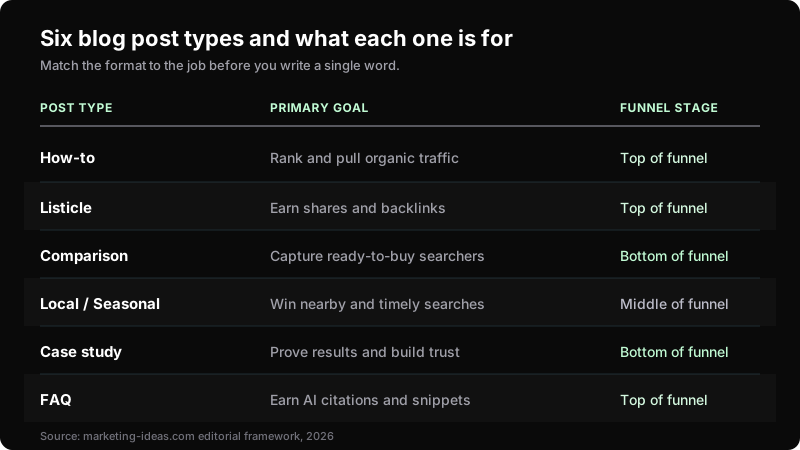
Here's the same idea as a planning table you can steal for your own calendar.
| Post type | Primary goal | Example title | Funnel stage |
|---|---|---|---|
| How-to | Rank and pull organic traffic | "How to Unclog a Drain Without a Plumber" | Top |
| Listicle | Earn shares and backlinks | "12 Budget Date-Night Spots Downtown" | Top |
| Comparison | Capture ready-to-buy searchers | "Invisalign vs Braces: Cost and Timeline" | Bottom |
| Local / Seasonal | Win nearby and timely searches | "Best Patios for Summer in [City]" | Middle |
| Case study | Prove results and build trust | "How We Cut a Client's Energy Bill 40%" | Bottom |
| FAQ | Earn AI citations and snippets | "How Much Does a Roof Replacement Cost?" | Top |
A blog that mixes all six types builds authority faster than one that only publishes how-tos. Google and AI engines want depth across the whole journey, not one note played over and over.
50 Blog Post Ideas by Industry
These are starting points, not finished titles. Swap in your city, your price, your specifics. The more concrete you make them, the better they rank.
Restaurants & Food
- "The 10 Best [Cuisine] Dishes to Order at [Restaurant Name]"
- "How to Host a Private Event at Our [City] Location"
- "What's in Season: Our [Month] Menu Explained"
- "5 Wine Pairings for Our Most Popular Dishes"
- "Behind the Scenes: A Day in Our Kitchen"
- "Gluten-Free and Vegan Options at [Restaurant]: The Full List"
- "How to Get a Reservation on a Friday Night (Insider Tips)"
Restaurants live and die on local search. Every one of these ties to a "near me" query or a booking decision. For the full playbook, see our restaurant marketing guide and own your local pack.
Home Services & Trades
- "How Much Does a [Service] Cost in [City]? 2026 Pricing Guide"
- "5 Signs You Need to Replace Your [System] Now"
- "DIY vs Hiring a Pro: When to Call a [Trade]"
- "How to Prepare Your Home Before Our [Service] Visit"
- "The Real Cost of Ignoring [Common Problem]"
- "Emergency [Service] in [City]: What to Do First"
- "How Long Does a [Repair/Install] Actually Take?"
Cost and "how to" posts dominate here because homeowners research before they call. Answer the money question honestly and you win the trust — and the booking.
Health & Wellness
- "What to Expect at Your First [Appointment Type]"
- "[Condition]: Symptoms, Causes, and When to See Us"
- "5 Myths About [Treatment], Debunked"
- "How to Choose the Right [Provider] in [City]"
- "Insurance and [Service]: What's Covered and What's Not"
- "Our Approach to [Treatment] vs the Standard Method"
- "A Week of [Healthy Habit]: A Beginner's Plan"

Professional Services
- "How Much Does a [Service] Cost? A Transparent Breakdown"
- "[Service] Checklist: What You Need Before We Start"
- "5 Mistakes People Make When Choosing a [Professional]"
- "DIY vs Hiring a [Professional]: An Honest Comparison"
- "What Happens After You Hire Us: The Full Process"
- "[Regulation/Deadline] Explained for [City] Small Businesses"
- "Case Study: How We Helped [Client Type] Save [Result]"
Professional services buyers want proof and clarity. Case studies and process posts do the heavy lifting. For turning one client win into a week of content, see how to repurpose a blog post into 10 pieces of content.
E-commerce & Retail
- "[Product] Buying Guide: How to Choose the Right One"
- "[Product A] vs [Product B]: Which Should You Buy?"
- "How to Care for Your [Product] So It Lasts Years"
- "10 Ways to Use [Product] You Haven't Thought Of"
- "The Best [Product] for [Specific Use Case]"
- "Gift Guide: [Product Category] for [Occasion]"
- "Our Return and Warranty Policy, Explained Simply"
Buying guides and comparisons convert because the reader is already shopping. Layer in a social media plan to push these posts to people mid-scroll, then capture buyers with email marketing.
SaaS & Tech
- "How to [Achieve Outcome] With [Your Tool]: Step by Step"
- "[Your Product] vs [Competitor]: An Honest Comparison"
- "The [Industry] Workflow We Built for [Customer Type]"
- "How [Customer] Cut [Metric] by [X]% Using [Product]"
- "[Common Task]: The Manual Way vs the Automated Way"
- "Integrations Guide: Connecting [Tool] to Your Stack"
- "What [Feature] Actually Does (and When to Use It)"
Comparison and use-case posts are gold for SaaS. They catch buyers evaluating options. If you're pre-launch, our organic user growth guide covers channels that fit these posts.
Real Estate
- "[Neighborhood] Buyer's Guide: What You Need to Know in 2026"
- "How Much House Can You Afford in [City]?"
- "5 Things to Fix Before You List Your Home"
- "Renting vs Buying in [City]: The Real Numbers"
- "The Home Inspection: What Every Buyer Should Expect"
- "[City] Market Update: What's Happening This Quarter"
- "First-Time Buyer Mistakes That Cost Thousands"
Neighborhood guides and market updates keep real estate blogs fresh and locally relevant. That freshness signals authority to both Google and AI search engines. To go deeper on AI visibility, see how to get cited by ChatGPT and Perplexity.
How Often Should a Small Business Blog?
Consistency beats volume. One genuinely useful post per week outperforms ten thin ones dumped in a month. HubSpot's research found companies that publish consistently generate far more leads — but the operative word is consistently, not frantically.
For most small businesses, one to two quality posts a week is the sweet spot. That's enough to signal an active site without wrecking your quality. If you can only manage two solid posts a month, do that — and do it every month without fail.
What matters more than raw count is topical depth. Ten posts that all circle one theme — say, "roof repair" — build authority faster than ten scattered across unrelated topics. Backlinko's analysis of 11.8 million search results found comprehensive, in-depth content correlates with higher rankings.
Pick a cadence you can hold for a year. Then cluster your posts around a few core themes. Slow and deep beats fast and shallow every time.
Frequently Asked Questions
How many blog post ideas do I need to start?
Ten to twelve is plenty to launch. That's roughly a quarter of weekly posts. Pull two or three from each idea source — search intent, customer questions, comparisons — and you'll have a backlog before you write word one. Add new ideas as customer questions come in.
Do small business blogs still work for SEO in 2026?
Yes, but the bar is higher. Google's helpful content guidance rewards first-hand experience and depth over keyword-stuffed filler. A local business answering real customer questions with specifics still ranks — and increasingly gets cited in AI answers too. Generic AI-spun posts don't.
How long should each blog post be?
Long enough to fully answer the question, not a word more. A pricing FAQ might be 600 words. A buyer's guide might be 2,500. Backlinko's data shows longer content tends to rank better, but only because depth usually means a more complete answer — not because length alone helps.
What's the difference between a blog post idea and a keyword?
A keyword is the phrase people search ("emergency plumber Austin"). The idea is the angle you take on it ("Emergency Plumber in Austin: What to Do in the First 10 Minutes"). Start with the keyword for demand, then shape an idea that answers it better than page one.
Should I use AI to generate blog post ideas?
Use it to expand, not to decide. AI is great for brainstorming variations once you feed it real customer questions and search terms. But it can't tell you what your specific customers ask. Our Claude AI prompts for marketers show how to prompt for ideas that don't read like every other AI blog.
Sources
- HubSpot, "Marketing Statistics," retrieved 2026-07-03, https://www.hubspot.com/marketing-statistics
- Ahrefs, "90.63% of Content Gets No Traffic From Google," retrieved 2026-07-03, https://ahrefs.com/blog/search-traffic-study/
- Backlinko, "We Analyzed 11.8 Million Google Search Results," retrieved 2026-07-03, https://backlinko.com/search-engine-ranking
- Semrush, "State of Content Marketing," retrieved 2026-07-03, https://www.semrush.com/blog/content-marketing-statistics/
- BrightLocal, "Local Consumer Review Survey," retrieved 2026-07-03, https://www.brightlocal.com/research/local-consumer-review-survey/
- Content Marketing Institute, "B2B Content Marketing Benchmarks," retrieved 2026-07-03, https://contentmarketinginstitute.com/articles/b2b-content-marketing-research/
- Google Search Central, "Creating Helpful, Reliable, People-First Content," retrieved 2026-07-03, https://developers.google.com/search/docs/fundamentals/creating-helpful-content